
Termite Treatment in Nutley, NJ
Subterranean termite inspection, soil treatment and baiting for Nutley homes and buildings. Free estimate, written scope.


Full Foundation Inspection
Garage slab joints, porch fill, crawlspace piers and the finished basement wall — the places termites actually enter a detached Nutley house, checked and recorded.
Soil Treatment or Baiting
A trenched and rodded non-repellent barrier, or monitored bait stations that remove the colony. We set out what each involves before anything is scheduled.
NPMA-33 Reports for Sales
The standard wood-destroying insect report used in real estate transactions, written from a visual inspection and clear about what could and could not be seen.
Local Termite Treatment for Nutley Property Owners
We are a pest control company working across Essex County, and Nutley is one of the places we are called to most often. What follows is what we actually know about termite treatment here — the building types, the conditions that drive it, and the local rules — rather than a page of stock copy with a place name dropped into it.
If something is turning up in your Nutley home or business, call (862) 256-6829 for an inspection. You will get an honest read on what is there and a written estimate before anything is scheduled.

Nutley, NJ at a Glance
Nutley sits in Essex County at roughly 52 feet above sea level and is home to about 30,143 people. Those numbers matter more than they look: density, elevation and age of the housing stock are the three things that decide which pests a place actually gets.
| Population | 30,143 (2020 Census) |
|---|---|
| County | Essex County, NJ |
| Elevation | 52 feet above sea level |
| ZIP codes | 07110 |
Population from the 2020 US Census. Elevation, ZIP and founding data via Wikidata.
Pest Pressure in Nutley This Week
Today in Nutley: Slight Chance Showers And Thunderstorms then Mostly Sunny, around 84°F. A slight chance of showers and thunderstorms before 8am. Mostly sunny, with a high near 84. Northwest wind 3 to 8 mph. Chance of precipitation is 20%. New rainfall amounts less than a tenth of an inch possible.
Tonight 66°F, partly cloudy · Saturday 80°F, sunny · Saturday Night 63°F, partly cloudy
Right now mosquito pressure is high because of mean temperatures around 78°F.
How weather drives termites. Swarming is the one weather-timed event: Eastern subterranean termites typically swarm on warm days after rain between March and May, which is when the swarm row appears in the panel above. The feeding colony is a different matter — it works in the soil and inside wood through most of the year, slowing in cold ground but not stopping, and in heated basements it can stay active all winter. A quiet panel means no swarm is likely this week, not that there are no termites.
Forecast from the National Weather Service (public domain). Pest pressure is our own index, calculated from temperature, rainfall and humidity. Updated 2026-09-04.
Is It Termites? Swarmers, Tubes and Damaged Wood
Suburban New Jersey is termite country. The species is the Eastern subterranean termite (Reticulitermes flavipes), a soil-nesting insect whose colonies are common in wooded and landscaped lots across the state. Formosan termites are not established here and drywood termites belong to warmer climates, so the question is almost never which termite — it is whether what you found is a termite at all.
Swarmer or flying ant? Three features settle it:
- Wings. A termite swarmer has two pairs of wings of equal length, extending well beyond the body and shed within hours. A winged ant's front wings are clearly longer than its hind wings.
- Waist. Termites are broad-waisted, almost tubular. Ants are pinched sharply between thorax and abdomen.
- Antennae. Termite antennae are straight and beaded. Ant antennae are elbowed.
The evidence left behind is usually more useful than the insects. Shed wings in piles on sills and basement floors. Mud tubes, pencil-width earthen runways up a foundation wall, a pier or a pipe, which workers build because they dry out in open air. And damaged wood: termites eat the softer springwood and leave the harder bands, so the galleries follow the grain and are packed with soil and faecal material. Hollow-sounding wood or blistered paint on a sill is worth probing.
The common look-alike is the carpenter ant (Camponotus pennsylvanicus). It nests in wood rather than eating it, so its galleries are clean and smooth, with coarse frass of shavings and insect parts pushed out. Soil in the galleries means termites; clean galleries and a sawdust pile mean ants and, nearly always, a moisture problem.
How Termites Reach a Detached House
A detached Nutley house on a planted lot offers more ways in than an attached one, nearly all at ground level.
- Mulch and soil against the siding. Deep mulch beds keep the soil moist and bridge any gap between grade and wood. Several inches of visible foundation between soil and siding is the single most useful habit a homeowner can have.
- Garage slab and porch joints. The expansion joint where the garage slab meets the foundation, and the fill under porches, steps and stoops, give termites a hidden route to the sill plate. The attached garage is one of the most common entry points we see.
- Crawlspaces. Exposed soil, damp air, piers with wood resting on them, and form boards left from construction. A crawlspace with a moisture problem is a crawlspace with a termite risk.
- Wood touching soil. Deck posts, fence lines butted to the house, trellises, stair stringers and buried construction wood or old tree stumps close to the foundation.
- Gutters and downspouts that overflow or discharge against the foundation, and irrigation heads spraying the wall.
- Finished basements. Framed and panelled walls hide tubes on the foundation for years. Additions and sunrooms on slabs are another blind spot, because the joint between old and new foundation is hard to see.

Soil Treatment, Baiting and What Actually Works
On a detached house the full range of methods is usually available, and the choice comes down to the building, the site and how quickly you need activity stopped.
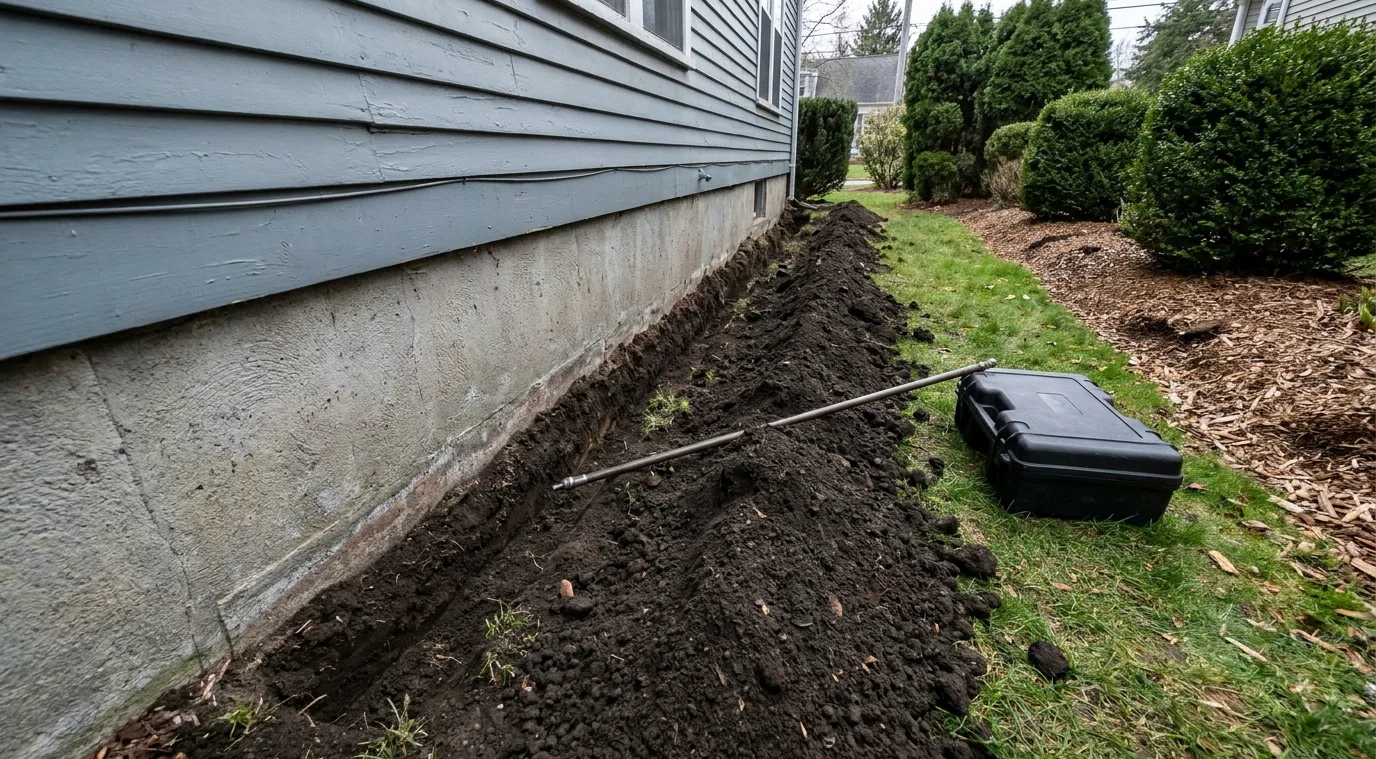
Liquid soil treatment puts a continuous treated zone where termites travel to reach the building: a narrow trench along open foundation, with rodding below it toward the footing, and drilling at close intervals through slabs, porches and cellar floors, which are then patched. Volume is the whole game, applied to the product label.
Non-repellent or repellent. Non-repellents — fipronil, imidacloprid, chlorantraniliprole — cannot be detected, so workers pass through, pick up a dose and carry it back. Repellent pyrethroids such as bifenthrin form a barrier the insects avoid, which only holds if it has no gaps.
Baiting systems work the other way round. Monitoring stations go into the soil around the building and are checked on a schedule; once termites are feeding, a cellulose bait with a chitin synthesis inhibitor (noviflumuron, hexaflumuron) goes in, which stops workers moulting. The colony declines over months. Slower, but it targets the colony and needs no drilling.
Spot treatments and borates. Foam injected into an active gallery kills the termites in that wood, not the colony in the soil. Borate (disodium octaborate tetrahydrate) on bare, unfinished wood protects that timber — ideal when joists and sills are exposed during renovation — but does nothing to the soil.
Why do-it-yourself products fail. Spraying a visible tube kills a handful of workers while the colony, foraging over tens of metres of soil, builds another. Consumer products cannot reach the depth and volume a foundation needs. Breaking a tube and watching whether it is rebuilt is useful diagnosis, not treatment.
Tell us about any private well before the inspection. Labels restrict soil treatment near wells and cisterns, and baiting may be the right answer there.

Buying, Selling and the Termite Inspection Report
Most termite questions in suburban New Jersey come up at one of two moments: when swarmers appear in spring, and when a house is being sold.
The NPMA-33 report. The Wood Destroying Insect Inspection Report is the standard form used in real estate transactions here, routinely requested by buyers and lenders. It records whether visible evidence of termites and other wood-destroying insects was found, where, and whether there is visible damage. Two things it is not: it is not a warranty that the building is free of termites, and it is not a structural assessment. It is a visual snapshot of the accessible areas on the day. Finished walls, stored contents and floor coverings hide evidence; read the section listing what could not be inspected.
If evidence is found during a sale, ask whether it is active or old, whether there is treatment paperwork, whether any service agreement transfers, and have damage assessed by a contractor or engineer. Old damage from a treated colony is common and not in itself a reason to walk away.
What a thorough termite estimate includes: where activity was found; the conducive conditions to correct; the method and why it suits this building; the product class; how often bait stations are checked, if baiting; and re-inspection and re-service terms in writing. Ask for the applicator's certification for termite work — in New Jersey termites and wood-destroying insects are their own certification category (7B).
General information about the rules as written, not legal advice about your situation. Confirm current requirements with the agency named before relying on them.
Termite Treatment — Common Questions
Our neighbours had termites. Are we at risk?
You are in the same soil, and colonies forage well beyond one lot, so it is a reasonable prompt for an inspection. Risk at your house depends on your own conditions — mulch against the siding, wood touching soil, moisture in the crawlspace or basement — and those are things you can change regardless.
We have a finished basement. How can anyone tell?
Not completely. An inspection looks at the exterior foundation, the garage, the utility room, the unfinished sections, the sill wherever it is visible, and any sign on finished surfaces such as blistered trim or wings at windows. The report states which areas were concealed, and that limitation is real.
How long does baiting take?
Monitoring stations may take weeks or months to be found. Once feeding is confirmed and bait is in place, colony decline typically takes a few months, which is why stations are checked on a schedule. Soil treatment stops activity faster; baiting removes the colony more thoroughly.
Pest Pressure in Nutley, NJ
Nutley covers about three and a half square miles between Bloomfield and Clifton, and the Third River running through the middle of it is the single most useful thing to know. The river and its low ground hold water long after a storm, keep soil damp against foundations on the properties near it, and are where most of the township's mosquito problem originates. Sections of Nutley near the river have a real and recurring flooding history, and a basement that takes water even occasionally is a different pest proposition from one that never does.
Yanticaw Park and Kingsland Park follow the river corridor and give the surrounding streets both the mosquito pressure and the wooded-edge wildlife pressure. Nutley Center along Franklin Avenue is the commercial spine, with the food businesses and shared rear refuse that set local rodent pressure. The Spring Garden, Radcliffe and Franklin sections each sit slightly differently relative to the river valley, and the western edge toward Clifton rises to drier ground.
Nutley uses ZIP 07110.
What Nutley Buildings Are Made Of
Nutley's stock is a fairly even mix of pre-war and post-war, and it fails in correspondingly different ways.
The older sections have Victorians and early twentieth-century frame houses with porches, complex rooflines and, in many cases, balloon-framed walls where the cavity runs uninterrupted from sill plate to attic. Those complex roofs mean valleys and flashings that eventually leak, and long-wet wood is what carpenter ants excavate.
Through the middle of the township, two-family frame houses and post-war colonials and capes on modest lots with full basements and detached or tucked-under garages. Full basements near the river run damp, and a damp basement with a wood sill close to grade is close to ideal for Eastern subterranean termites. Mud tubes on an older brick or rubble foundation are easy to miss because the surface is already irregular.
There is a layer of garden apartments and smaller multi-family buildings along the corridors, where entry is at the slab edge and thresholds and ground-floor units take most of the mouse activity.
Mature street trees throughout the township give squirrels roof access on the older blocks.
The Calls We Get Most in Nutley
Termites in the older frame stock near the river. Damp soil against low sill plates.
Mosquitoes in the blocks along the Third River and the parks. Peaking about a week to ten days after heavy rain.
Carpenter ants in the older houses. Tracking a roof, gutter or porch-roof leak rather than arriving on their own.
Basement pests after flooding. Water in a basement brings springtails, silverfish, camel crickets and, where the sewer surcharges, American cockroach.
Mice through tucked-under garages and at the sill in autumn.
Squirrels in attics on the older tree-lined blocks. Overhanging limbs to soffit returns.
Rats behind the Franklin Avenue businesses. Rear-yard refuse and shared bins.
Local Rules and Who to Call in Nutley
Nutley's health department and code enforcement handle property maintenance and pest complaints, and rental buildings of five units or more are registered under the Hotel and Multiple Dwelling Law and inspected by the New Jersey Department of Community Affairs. The service most worth knowing about here is the Essex County mosquito control programme, which carries out larval surveillance and treats catch basins and standing water on public land at no charge, and responds to reports of standing water. Because so much of Nutley's mosquito breeding happens in the Third River corridor and the parks rather than in back gardens, that public work reaches sources that no amount of private yard treatment can. For property transactions, the termite inspection is the NPMA-33 form, and it covers visually accessible areas only.
Areas We Cover in Nutley
- Nutley Center
- Spring Garden
- Radcliffe
- Franklin
- Yanticaw Park area
- Kingsland Park area
- Franklin Avenue corridor
- Third River corridor
ZIP 07110 covers the township.
Nutley — Local Questions
Our basement takes water in big storms and now we have insects down there. Related?
Directly. A basement that floods or stays damp attracts an entire moisture-dependent group — springtails, silverfish, camel crickets and centipedes — that will not persist in a dry one. If the water is coming up through a floor drain rather than in from outside, you may also be getting American cockroaches from the sewer. The pest treatment is the easy half; the durable fix is the water, through grading, downspout extensions and drain maintenance.
Is the mosquito problem here worse because of the river?
Yes, and the important consequence is where the breeding actually happens. Mosquitoes from the Third River corridor and the low ground in the parks are not breeding on your property, so treating only your garden means treating the adults that arrive rather than the source. Do the container work at home — gutters, tarps, saucers, corrugated drain pipe — and report standing water to Essex County mosquito control, which treats the public-side sources at no cost.
Termite Treatment Near Nutley
We cover the surrounding towns from the same base, so if you are just outside Nutley the nearest service pages are below.
- Termite Treatment in Bloomfield, NJ 2 mi
- Termite Treatment in Belleville, NJ 2 mi
- Termite Treatment in Montclair, NJ 3 mi
- Termite Treatment in Clifton, NJ 3 mi
- Termite Treatment in Passaic, NJ 3 mi
In Nutley we also handle pest control, rodent control, bed bug treatment, cockroach control, and mosquito control. Our main service pages cover cockroach control, termite treatment and mosquito control.
📍 On the map
Found Wings on a Windowsill?
Shed wings or mud tubes on the foundation are worth a look before the damage is. Free estimate, written scope.
Call About TermitesHow Termite Treatment Runs in Nutley
Four stages, from the first sign to the monitored barrier
Termite work is slow and structural, and the order matters. This is the sequence a Nutley job follows.