
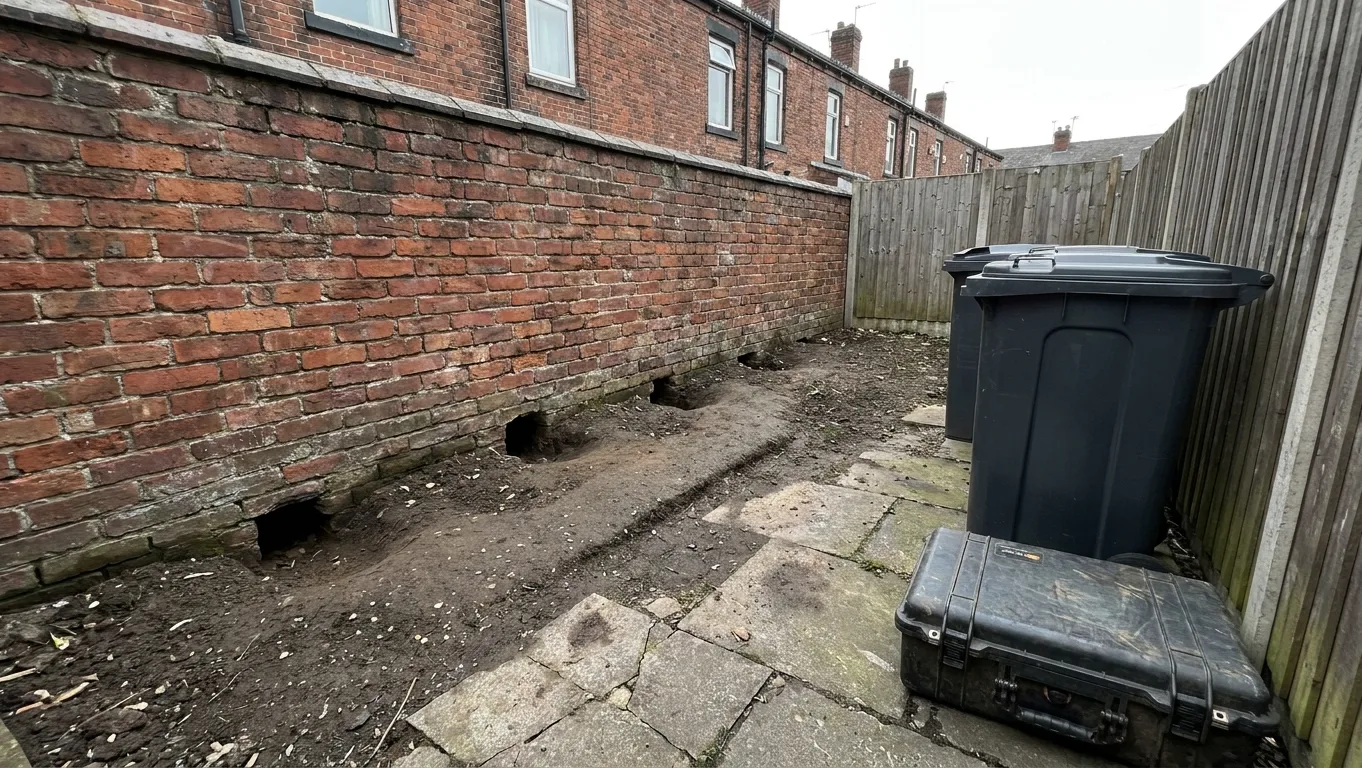
Rat Removal & Exterminator in Nutley, NJ
Burrow mapping, trapping and entry sealing for Nutley homes, buildings and yards. Free estimate, written scope.


Yard and Outbuilding Survey
Sheds on skids, decks, woodpiles and compost bins are where Nutley rats dig in. We walk the whole lot, not just the side of the house where you saw one.
Trap-Shy Rats Handled
Norway rats avoid anything new in their path. Traps go out unset and baited first, so the colony gets used to them before they start catching.
Digging Barriers That Last
Buried hardware-cloth skirts around sheds and decks stop the burrowing that wood lattice and landscape fabric never will.
Local Rat Removal & Exterminator for Nutley Property Owners
We are a pest control company working across Essex County, and Nutley is one of the places we are called to most often. What follows is what we actually know about rat removal & exterminator here — the building types, the conditions that drive it, and the local rules — rather than a page of stock copy with a place name dropped into it.
If something is turning up in your Nutley home or business, call (862) 256-6829 for an inspection. You will get an honest read on what is there and a written estimate before anything is scheduled.

Nutley, NJ at a Glance
Nutley sits in Essex County at roughly 52 feet above sea level and is home to about 30,143 people. Those numbers matter more than they look: density, elevation and age of the housing stock are the three things that decide which pests a place actually gets.
| Population | 30,143 (2020 Census) |
|---|---|
| County | Essex County, NJ |
| Elevation | 52 feet above sea level |
| ZIP codes | 07110 |
Population from the 2020 US Census. Elevation, ZIP and founding data via Wikidata.
Pest Pressure in Nutley This Week
Today in Nutley: Slight Chance Showers And Thunderstorms then Mostly Sunny, around 84°F. A slight chance of showers and thunderstorms before 8am. Mostly sunny, with a high near 84. Northwest wind 3 to 8 mph. Chance of precipitation is 20%. New rainfall amounts less than a tenth of an inch possible.
Tonight 66°F, partly cloudy · Saturday 80°F, sunny · Saturday Night 63°F, partly cloudy
Right now mosquito pressure is high because of mean temperatures around 78°F.
How weather moves rats. Heavy rain is the event to watch: it floods burrows and surcharges sewers, and rats that lose their shelter surface in cellars, yards and drains within a day or two. A hard cold snap pushes more of them toward heated buildings, while long dry spells send them looking for water near hose bibs, drains and pet bowls. The rodent bar above reflects those triggers — it can tell you when pressure is likely to rise, not whether rats are already on your property.
Forecast from the National Weather Service (public domain). Pest pressure is our own index, calculated from temperature, rainfall and humidity. Updated 2026-09-04.
Mice, Rats or Both? Rodent Help in Nutley
Mice and rats get in differently, live differently and are dealt with differently, so we run three separate Nutley pages. Pick the one that matches what you are finding.
Norway Rat Signs — Burrows, Runways and Droppings
The Norway rat (Rattus norvegicus) is the rat this region has: heavy and blunt-nosed, with a body of up to about 25 centimetres and a slightly shorter scaly tail, living at ground level and below it.
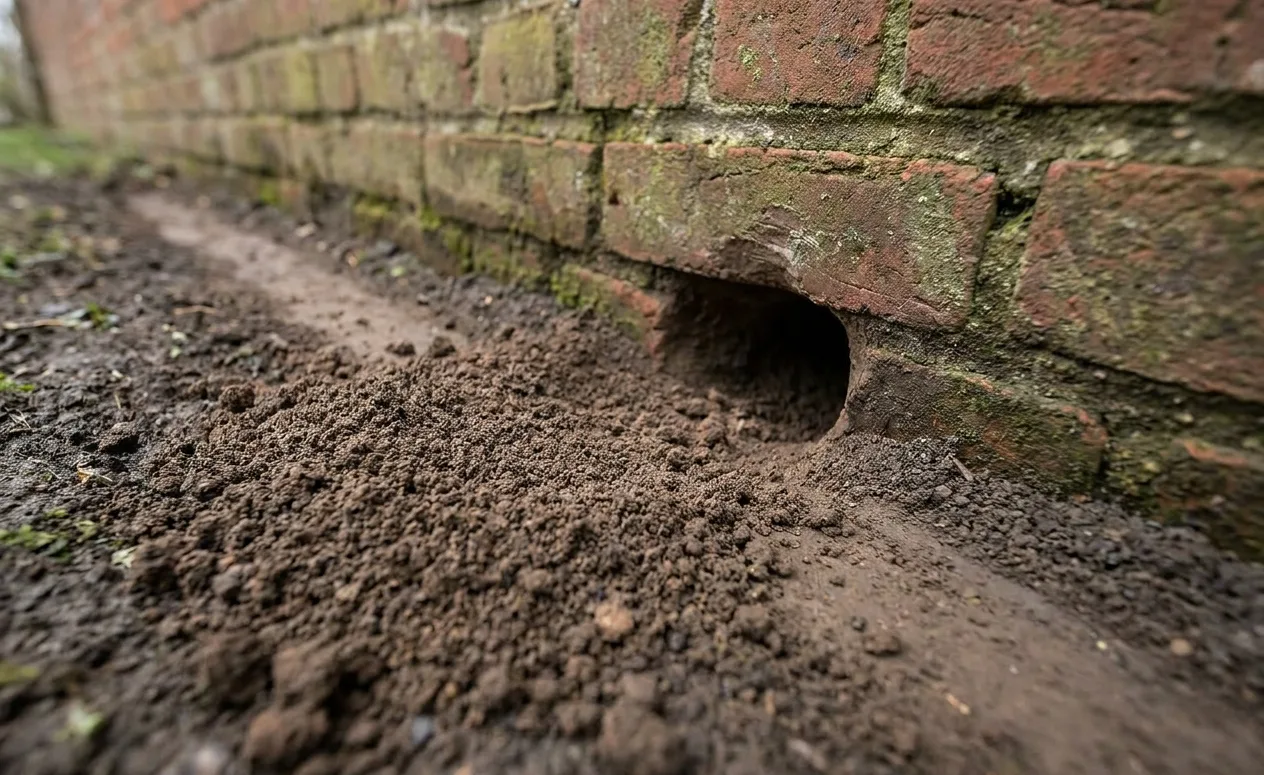
- Burrow entrances. Round holes roughly the width of a tennis ball, with smooth, packed edges and a fan of loose soil thrown out in front. A clean rim with no cobwebs or leaf litter means the hole is in use.
- Runways. Narrow paths worn bare through grass or packed into soil along walls, fences and foundation edges. Rats repeat the same route every night.
- Droppings. Dark, blunt-ended and about the size of a raisin or an olive pit, usually dropped in small clusters along runways and near food.
- Rub marks and gnawing. Dark smudges where fur brushes the same corner again and again, and chewed plastic bins, doors and pipe insulation.
- Sound. Heavier than mice — scrabbling, dragging and gnawing, mostly from dusk into the early morning.
A rat seen in daylight is worth taking seriously. Rats keep to the dark by choice, so daytime activity usually means crowding, a disturbed burrow or a food source they are competing for.
On a suburban lot, look under the deck, beside the shed, along the back fence and around the compost bin before looking in the house.
Where Rats Settle on a Suburban Lot
Rats are less common in detached neighbourhoods than in dense ones, but when they arrive they tend to settle into the same handful of places.
- Sheds and decks. A shed on skids or a low deck gives dry, dark cover with soft soil underneath. It is the most common burrow site we find on a detached lot.
- Food left outside. Bird feeders dropping seed, pet food stored in the garage, fallen fruit, open compost with food scraps and backyard chicken feed will each support a colony.
- Woodpiles and dense planting. Firewood stacked against the house and thick ground cover along the foundation hide both runways and burrow openings.
- Water. Ponds, dripping hose bibs, pool equipment and stormwater retention basins all draw them.
- Nearby commercial land. Houses backing onto shopping strips, restaurants, rail lines or construction sites see more pressure, because the colony's main food supply is next door.
From outside, the usual way in is low: a gap under the garage door, a hole where a utility line enters, or a crawlspace vent with a torn screen.
Removing Rats — the Order That Works
Rats are suspicious of anything new. A trap that appears overnight on a runway is often walked around for days. That caution, called neophobia, is why a rat program starts with pre-baiting: large rat traps go out baited but unset, placed along walls and runways inside covered boxes, and are only armed once the rats are feeding from them freely. Set them too early and the colony learns to avoid them.
Size matters. Mouse traps only injure rats. Rat work uses heavy snap traps or enclosed trap boxes, set perpendicular to the wall with the trigger on the runway, and plenty of them — rats rarely all feed from one spot.
Removing the food and cover goes alongside the trapping, or the next colony simply moves into the same spot. Feeders come down for a few weeks, firewood goes up on racks well clear of the walls, and compost goes into a closed, rat-resistant bin.
Digging barriers. The lasting fix for a shed or deck is a skirt of galvanised hardware cloth buried around the edge and bent outward in an L at the bottom, so a rat digging down meets mesh rather than soil.
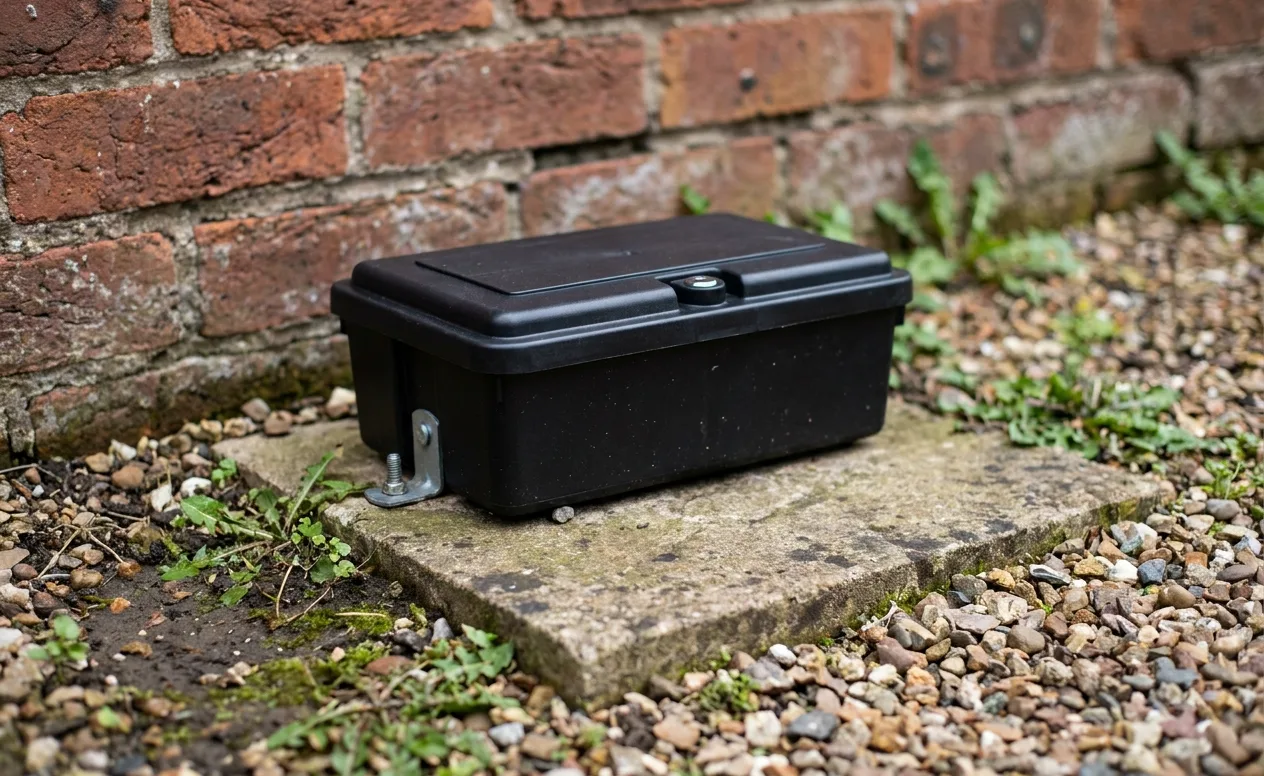
Exterior bait stations. Outside, a program usually adds locked, weighted or anchored stations along the foundation and fence lines where runways are active. The strongest rodenticides — the second-generation anticoagulants — have been withdrawn from consumer products in the US and are limited to professional use for exactly this reason: an animal that eats them stays poisonous to the hawks, foxes, cats and dogs that may find it. Stations are checked and logged on every visit, and bait is removed once feeding stops rather than left out indefinitely.
Burrows. After treatment, active holes are packed with soil and checked on the next visit. A hole that has been dug open again is the clearest sign the colony is still there; a hole that stays closed across several visits is the sign it is not.
Dead rats and odour. A rat that dies inside a wall or ceiling produces a strong smell that can last one to three weeks. Flies gathering at one spot on a wall, or a stain on a ceiling, usually points to it. A reachable carcass is removed with gloves, bagged, and the area disinfected — soak droppings and nesting material with disinfectant before wiping, never sweep them up dry. Where it cannot be reached, ventilation and time are often the only option, which is one more reason interior work relies on traps.
What the visits look like.
- First visit: mark every burrow, runway and entry point inside and out; set pre-baited traps and, where needed, exterior stations; note what the rats are eating and drinking.
- Weekly visits: arm traps once feeding is steady, log catches and station feeding, and move equipment to where the activity is.
- Exclusion: seal the gaps the survey found — concrete and hardware cloth at the foundation, door sweeps, vent screens, pipe penetrations.
- Close-out: no fresh burrow openings, no new droppings and no feeding across two or three consecutive visits. That is the finish line, and it should be written down.
Neighbours, Ordinances and Health
On a detached lot the responsibility is simpler: the owner deals with their own property. What is harder is when the source is next door — an overgrown yard, a heap of rubbish, a feeder spilling seed.
A friendly conversation usually does more than anything else. If it does not, most New Jersey municipalities have property maintenance and nuisance ordinances covering rubbish, overgrowth and conditions that harbour rodents, enforced by the local code enforcement or health office. They can inspect and require the owner to correct it. For a rental house, the landlord is responsible for correcting an infestation; report it in writing first and keep a copy.
Where the source is a neighbouring food business, the local health department is the right contact.
Why it matters beyond the damage. Rat urine can carry leptospirosis, a bacterial infection spread mainly through contact with the urine of infected animals, and rats contaminate food and food-contact surfaces with salmonella. Norway rats can also carry Seoul virus, a hantavirus, although human cases in this country are rare. Do not handle rats, nests or droppings bare-handed, and treat anything they have touched as dirty until it is cleaned and disinfected.
General information about the rules as written, not legal advice about your situation. Confirm current requirements with the agency named before relying on them.
Rat Removal — Common Questions
Will taking the bird feeder down really make a difference?
Often a big one. Spilled seed on the ground is a steady, reliable meal, and a colony will settle within easy reach of it. Taking feeders down for a few weeks while the rats are removed, then using a tray or catch pan when they go back up, cuts off one of the most common suburban food sources.
There is a hole under our shed. Should we just fill it in?
Not on its own. Filling one hole usually means the rats open another beside it. The hole tells you where they live; removing them, then fitting a buried mesh skirt around the shed, is what stops them coming back.
Is it safe to use rat poison with a dog in the yard?
Only inside locked, anchored stations designed for the purpose, and it is worth telling us about pets before any work starts. The strongest products are restricted to professional use because a poisoned rat can in turn poison a dog that finds it.
Pest Pressure in Nutley, NJ
Nutley covers about three and a half square miles between Bloomfield and Clifton, and the Third River running through the middle of it is the single most useful thing to know. The river and its low ground hold water long after a storm, keep soil damp against foundations on the properties near it, and are where most of the township's mosquito problem originates. Sections of Nutley near the river have a real and recurring flooding history, and a basement that takes water even occasionally is a different pest proposition from one that never does.
Yanticaw Park and Kingsland Park follow the river corridor and give the surrounding streets both the mosquito pressure and the wooded-edge wildlife pressure. Nutley Center along Franklin Avenue is the commercial spine, with the food businesses and shared rear refuse that set local rodent pressure. The Spring Garden, Radcliffe and Franklin sections each sit slightly differently relative to the river valley, and the western edge toward Clifton rises to drier ground.
Nutley uses ZIP 07110.
What Nutley Buildings Are Made Of
Nutley's stock is a fairly even mix of pre-war and post-war, and it fails in correspondingly different ways.
The older sections have Victorians and early twentieth-century frame houses with porches, complex rooflines and, in many cases, balloon-framed walls where the cavity runs uninterrupted from sill plate to attic. Those complex roofs mean valleys and flashings that eventually leak, and long-wet wood is what carpenter ants excavate.
Through the middle of the township, two-family frame houses and post-war colonials and capes on modest lots with full basements and detached or tucked-under garages. Full basements near the river run damp, and a damp basement with a wood sill close to grade is close to ideal for Eastern subterranean termites. Mud tubes on an older brick or rubble foundation are easy to miss because the surface is already irregular.
There is a layer of garden apartments and smaller multi-family buildings along the corridors, where entry is at the slab edge and thresholds and ground-floor units take most of the mouse activity.
Mature street trees throughout the township give squirrels roof access on the older blocks.
The Calls We Get Most in Nutley
Termites in the older frame stock near the river. Damp soil against low sill plates.
Mosquitoes in the blocks along the Third River and the parks. Peaking about a week to ten days after heavy rain.
Carpenter ants in the older houses. Tracking a roof, gutter or porch-roof leak rather than arriving on their own.
Basement pests after flooding. Water in a basement brings springtails, silverfish, camel crickets and, where the sewer surcharges, American cockroach.
Mice through tucked-under garages and at the sill in autumn.
Squirrels in attics on the older tree-lined blocks. Overhanging limbs to soffit returns.
Rats behind the Franklin Avenue businesses. Rear-yard refuse and shared bins.
Local Rules and Who to Call in Nutley
Nutley's health department and code enforcement handle property maintenance and pest complaints, and rental buildings of five units or more are registered under the Hotel and Multiple Dwelling Law and inspected by the New Jersey Department of Community Affairs. The service most worth knowing about here is the Essex County mosquito control programme, which carries out larval surveillance and treats catch basins and standing water on public land at no charge, and responds to reports of standing water. Because so much of Nutley's mosquito breeding happens in the Third River corridor and the parks rather than in back gardens, that public work reaches sources that no amount of private yard treatment can. For property transactions, the termite inspection is the NPMA-33 form, and it covers visually accessible areas only.
Areas We Cover in Nutley
- Nutley Center
- Spring Garden
- Radcliffe
- Franklin
- Yanticaw Park area
- Kingsland Park area
- Franklin Avenue corridor
- Third River corridor
ZIP 07110 covers the township.
Nutley — Local Questions
Our basement takes water in big storms and now we have insects down there. Related?
Directly. A basement that floods or stays damp attracts an entire moisture-dependent group — springtails, silverfish, camel crickets and centipedes — that will not persist in a dry one. If the water is coming up through a floor drain rather than in from outside, you may also be getting American cockroaches from the sewer. The pest treatment is the easy half; the durable fix is the water, through grading, downspout extensions and drain maintenance.
Is the mosquito problem here worse because of the river?
Yes, and the important consequence is where the breeding actually happens. Mosquitoes from the Third River corridor and the low ground in the parks are not breeding on your property, so treating only your garden means treating the adults that arrive rather than the source. Do the container work at home — gutters, tarps, saucers, corrugated drain pipe — and report standing water to Essex County mosquito control, which treats the public-side sources at no cost.
Rat Removal & Exterminator Near Nutley
We cover the surrounding towns from the same base, so if you are just outside Nutley the nearest service pages are below.
- Rat Removal & Exterminator in Bloomfield, NJ 2 mi
- Rat Removal & Exterminator in Belleville, NJ 2 mi
- Rat Removal & Exterminator in Montclair, NJ 3 mi
- Rat Removal & Exterminator in Clifton, NJ 3 mi
- Rat Removal & Exterminator in Passaic, NJ 3 mi
In Nutley we also handle rodent control, mouse control, and general pest control. Our main service pages cover rodent control, cockroach control and bed bug extermination.
📍 On the map
Holes Along the Fence Line?
Fresh burrows and worn runways mean rats are living on the lot now. Book a free estimate before the colony grows.
Call About RatsHow Rat Removal Runs in Nutley
From the first burrow found to a quiet yard, in four steps
Rat work is patient work, because rats are wary of change. Here is how a Nutley rat job unfolds from the first visit to the last.