
Termite Treatment in Kearny, NJ
Subterranean termite inspection, soil treatment and baiting for Kearny homes and buildings. Free estimate, written scope.


Porches, Sills and Shared Walls
In attached Kearny housing termites reach the frame through porch posts, stoops and the sill plate on the party wall. We inspect the whole line, not just the room with the wings.
Soil Treatment or Baiting
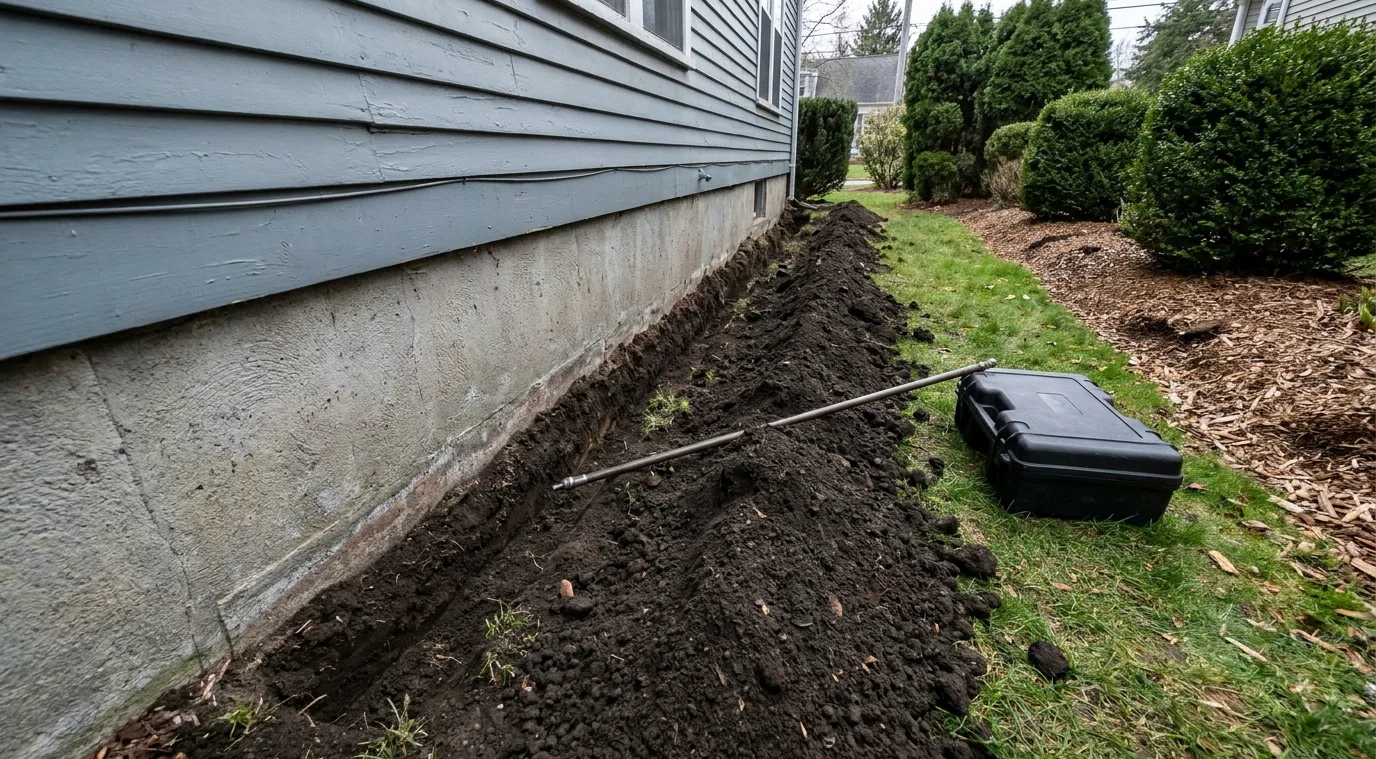
A liquid barrier works fast where the soil along the foundation can be reached. Baiting suits tight lots and slabs you cannot drill. We explain which fits your building.
Moisture Found First
Leaking downspouts, damp basements and wood touching soil are what draw termites in. The written report names them, so the treatment is not undone by the next storm.
Local Termite Treatment for Kearny Property Owners
We are a pest control company working across the NJ & NYC metro area, and Kearny is one of the places we are called to most often. What follows is what we actually know about termite treatment here — the building types, the conditions that drive it, and the local rules — rather than a page of stock copy with a place name dropped into it.
If something is turning up in your Kearny home or business, call (862) 256-6829 for an inspection. You will get an honest read on what is there and a written estimate before anything is scheduled.
Kearny, NJ at a Glance
Kearny sits in Hudson County at roughly 7 feet above sea level and is home to about 41,999 people. Those numbers matter more than they look: density, elevation and age of the housing stock are the three things that decide which pests a place actually gets.
| Population | 41,999 (2020 Census) |
|---|---|
| County | Hudson County, NJ |
| Elevation | 7 feet above sea level |
| ZIP codes | 07032, 07099 |
Population from the 2020 US Census. Elevation, ZIP and founding data via Wikidata.
Pest Pressure in Kearny This Week
Today in Kearny: Slight Chance Showers And Thunderstorms then Mostly Sunny, around 85°F. A slight chance of showers and thunderstorms before 8am. Mostly sunny, with a high near 85. Northwest wind 3 to 8 mph. Chance of precipitation is 20%. New rainfall amounts less than a tenth of an inch possible.
Tonight 67°F, partly cloudy · Saturday 81°F, sunny · Saturday Night 64°F, partly cloudy
Right now mosquito pressure is high because of mean temperatures around 77°F; general pest pressure is moderate because of daytime temperatures in the foraging range.
How weather drives termites. Swarming is the one weather-timed event: Eastern subterranean termites typically swarm on warm days after rain between March and May, which is when the swarm row appears in the panel above. The feeding colony is a different matter — it works in the soil and inside wood through most of the year, slowing in cold ground but not stopping, and in heated basements it can stay active all winter. A quiet panel means no swarm is likely this week, not that there are no termites.
Forecast from the National Weather Service (public domain). Pest pressure is our own index, calculated from temperature, rainfall and humidity. Updated 2026-09-04.
Is It Termites? Swarmers, Tubes and Damaged Wood
The termite in this part of New Jersey is the Eastern subterranean termite (Reticulitermes flavipes). It nests in the soil, not in the house, and reaches wood through earthen tubes or direct contact. Formosan termites are not established here, and drywood termites are a southern and western problem — if anyone mentions either, ask what they saw.
Swarmer or flying ant? Three features settle it:
- Wings. A termite swarmer has two pairs of wings of equal length, extending well beyond the body and shed within hours. A winged ant's front wings are clearly longer than its hind wings.
- Waist. Termites are broad-waisted, almost tubular. Ants are pinched sharply between thorax and abdomen.
- Antennae. Termite antennae are straight and beaded. Ant antennae are elbowed.
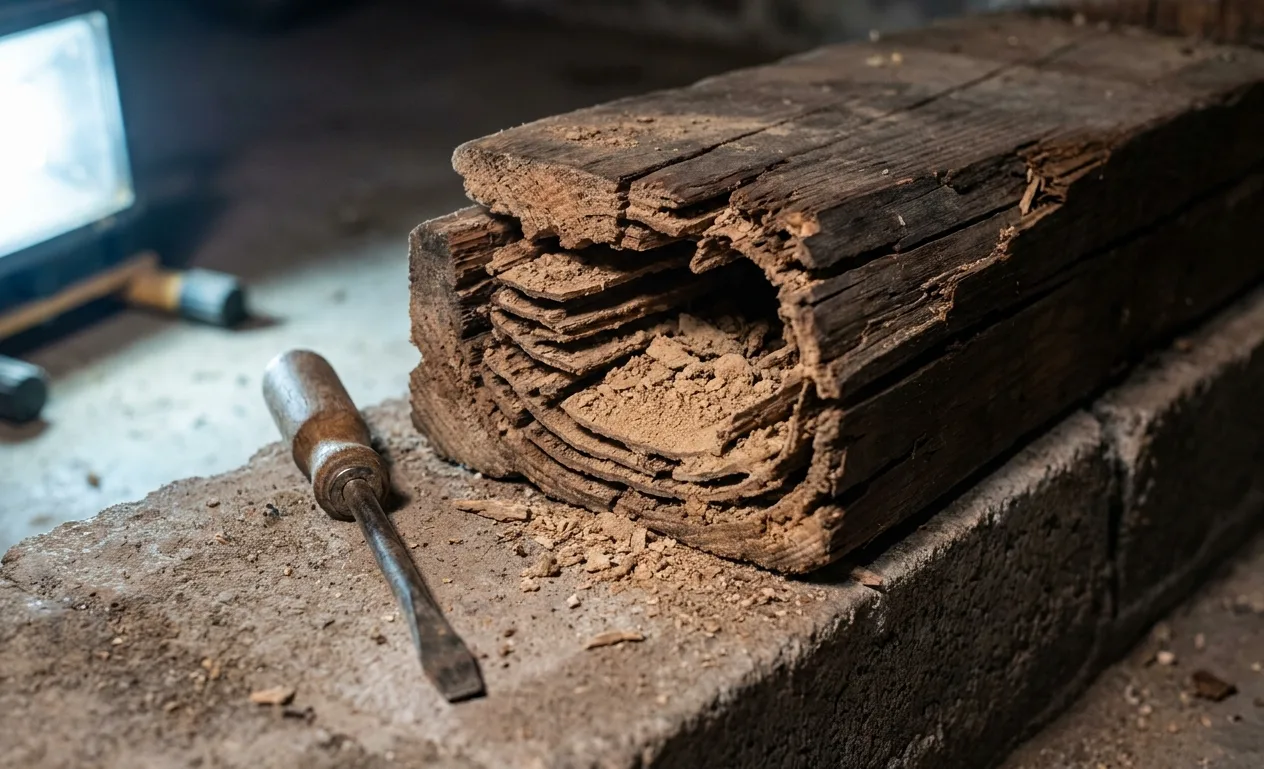
The evidence left behind is usually more useful than the insects. Shed wings in piles on sills and basement floors. Mud tubes, pencil-width earthen runways up a foundation wall, a pier or a pipe, which workers build because they dry out in open air. And damaged wood: termites eat the softer springwood and leave the harder bands, so the galleries follow the grain and are packed with soil and faecal material. Hollow-sounding wood or blistered paint on a sill is worth probing.
The common look-alike is the carpenter ant (Camponotus pennsylvanicus). It nests in wood rather than eating it, so its galleries are clean and smooth, with coarse frass of shavings and insect parts pushed out. Soil in the galleries means termites; clean galleries and a sawdust pile mean ants and, nearly always, a moisture problem.
Where Termites Get Into Older Attached Housing
Subterranean termites need soil moisture, so they enter at or below grade. In Kearny's older wood-frame two-families and row houses the entry points are predictable.
- Porches and stoops. Wooden porch posts set on or in the soil, and concrete stoops poured over fill against the house, are the most common entry we find. The fill under a stoop stays damp and hides the tubes.
- The sill plate and party wall. Where the timber sill sits close to grade, or where a shared wall runs into a damp cellar, termites can travel along it. In attached rows a colony does not respect the property line.
- Cellar floors and wood in contact with soil. Wooden posts on a dirt or cracked concrete floor, stair stringers resting on the slab, old form boards left in place, and storage timber on the ground.
- Leaks and poor drainage. A downspout discharging against the foundation, a failed gutter, or a rear yard that drains toward the house keeps the soil at the wall wet — exactly what a colony wants.
- Finished basements, where panelling hides tubes for years.
Heated cellars near boilers keep colonies active later into autumn and occasionally produce swarmers indoors in late winter.
Soil Treatment, Baiting and What Order to Do It In
On a narrow attached lot the method is usually decided by access. A side passage of bare soil can be trenched; a front stoop, a paved rear yard and a concrete cellar floor have to be drilled; a building where drilling is impractical may be better served by baiting.
Liquid soil treatment puts a continuous treated zone where termites travel to reach the building: a narrow trench along open foundation, with rodding below it toward the footing, and drilling at close intervals through slabs, porches and cellar floors, which are then patched. Volume is the whole game, applied to the product label.
Non-repellent or repellent. Non-repellents — fipronil, imidacloprid, chlorantraniliprole — cannot be detected, so workers pass through, pick up a dose and carry it back. Repellent pyrethroids such as bifenthrin form a barrier the insects avoid, which only holds if it has no gaps.
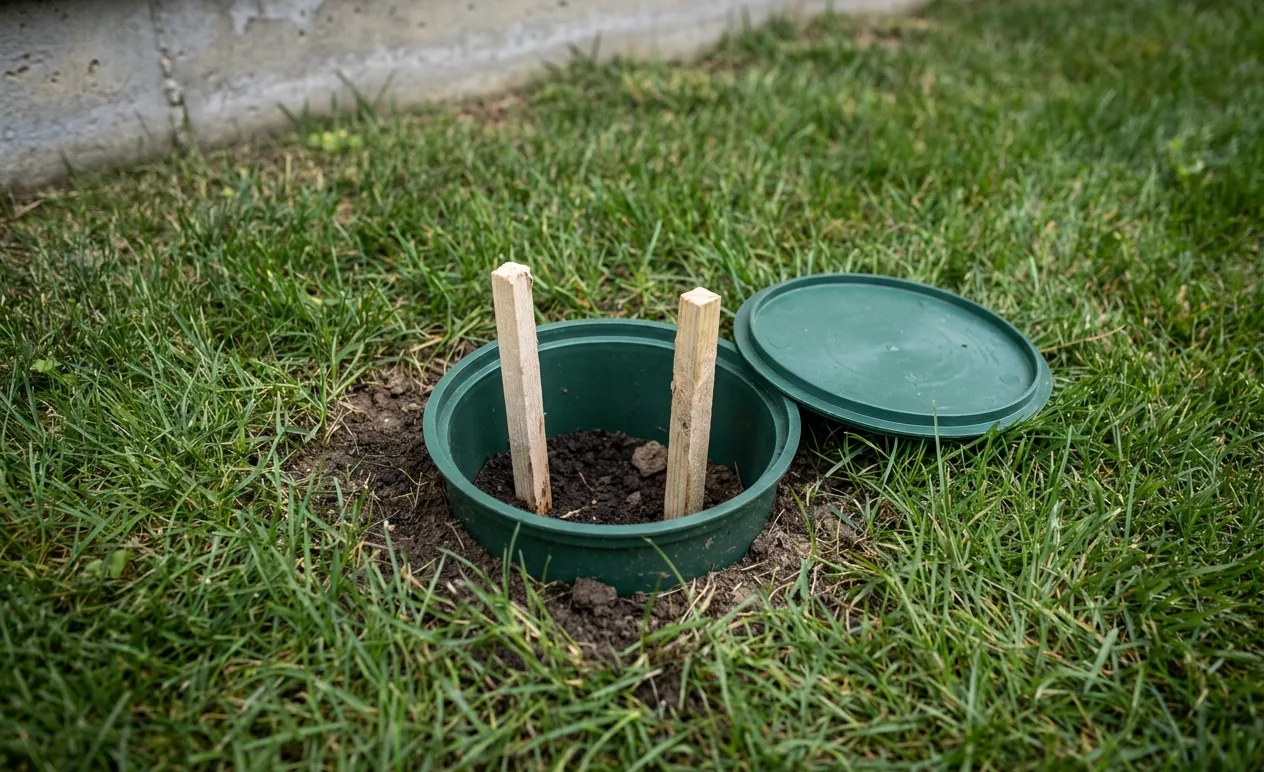
Baiting systems work the other way round. Monitoring stations go into the soil around the building and are checked on a schedule; once termites are feeding, a cellulose bait with a chitin synthesis inhibitor (noviflumuron, hexaflumuron) goes in, which stops workers moulting. The colony declines over months. Slower, but it targets the colony and needs no drilling.
Spot treatments and borates. Foam injected into an active gallery kills the termites in that wood, not the colony in the soil. Borate (disodium octaborate tetrahydrate) on bare, unfinished wood protects that timber — ideal when joists and sills are exposed during renovation — but does nothing to the soil.
Why do-it-yourself products fail. Spraying a visible tube kills a handful of workers while the colony, foraging over tens of metres of soil, builds another. Consumer products cannot reach the depth and volume a foundation needs. Breaking a tube and watching whether it is rebuilt is useful diagnosis, not treatment.
Correct the conditions at the same time. Pull soil and mulch back from the siding, redirect downspouts, get wood off the cellar floor, and fix leaks. Treatment addresses the termites; the conditions decide whether they come back.

Rentals, Shared Walls and Who Is Responsible
Termite damage is a structural condition, so in rented housing it is ordinarily the owner's responsibility, not the tenant's. If you rent and see swarmers or tubes, tell the landlord in writing, with the date and a photo, and keep a copy. Damage to joists, sills and porch structure is a property maintenance matter, and municipal code enforcement is the route if nothing is done. In registered multiple dwellings, the state Bureau of Housing Inspection is a second route.
For owners of attached buildings, the practical issue is the neighbour: a colony under a row ignores the property line, so treating one house while the next has active tubes on the shared foundation leaves a live source metres away. A written report is a better opening to that conversation than a guess.
The NPMA-33 report. The Wood Destroying Insect Inspection Report is the standard form used in real estate transactions here, routinely requested by buyers and lenders. It records whether visible evidence of termites and other wood-destroying insects was found, where, and whether there is visible damage. Two things it is not: it is not a warranty that the building is free of termites, and it is not a structural assessment. It is a visual snapshot of the accessible areas on the day. Finished walls, stored contents and floor coverings hide evidence; read the section listing what could not be inspected.
What a thorough termite estimate includes: where activity was found; the conducive conditions to correct; the method and why it suits this building; the product class; how often bait stations are checked, if baiting; and re-inspection and re-service terms in writing. Ask for the applicator's certification for termite work — in New Jersey termites and wood-destroying insects are their own certification category (7B).
General information about the rules as written, not legal advice about your situation. Confirm current requirements with the agency named before relying on them.
Termite Treatment — Common Questions
We found wings on the windowsill but no insects. Is that termites?
Possibly. Termite swarmers shed their wings within hours, so a pile of equal-length wings is often the only trace. Keep a few in a sealed bag or photograph them against a ruler, and look for mud tubes on the foundation wall below that window, inside and out. Winged ants leave wings too, but their front and hind wings differ in length.
Can termites spread from next door?
The colony lives in the soil and forages in whatever direction the food and moisture are, so in attached housing one colony can reach several buildings. That is why the inspection covers the shared foundation line, not just your side of it.
Do we have to leave during treatment?
Generally not for exterior soil treatment or baiting. Interior drilling of a cellar floor is noisy and dusty for a few hours, and you will be told which areas to clear and keep people and pets away from until applications have dried.
Pest Pressure in Kearny, NJ
Kearny covers about nine square miles between the Passaic and Hackensack Rivers, and it is really two very different places sharing one name. The northern two-thirds is a settled residential town on higher ground. The southern third — South Kearny and Kearny Point — is Meadowlands: tidal marsh, port and industrial land, rail, truck terminals and warehousing.
That marsh edge is the town's distinguishing pest feature. The Meadowlands are a genuine mosquito source on a scale nothing in Hudson County matches, and the tidal ditches, phragmites stands and impounded water on the industrial side produce salt-marsh mosquitoes that travel considerably further than the container breeders people find in their own yards. The industrial corridor also gives Norway rats unbroken harborage along rail beds, under pallets and decking, and around loading docks.
North of that, Kearny Avenue is the commercial spine, with the food businesses and shared rear refuse that set local rat pressure. The Arlington section at the northern end and the Manor section to the west are quieter residential blocks with more yard, more tree canopy and correspondingly more of the suburban pest list.
Kearny uses ZIPs 07032 and 07099.
What Kearny Buildings Are Made Of
Kearny's residential stock is mostly two-family frame houses and older colonials on modest lots, with narrow side yards, full basements and detached or tucked-under garages. A good deal of it dates to the town's industrial heyday, which means brick and rubble foundations, balloon-framed wall cavities running uninterrupted from sill to attic, and original sill plates sitting close to grade.
Balloon framing matters more than most homeowners realise. Where it survives, a mouse entering at the sill can travel inside the wall cavity all the way to the attic without crossing a single floor, which is why activity is so often reported on the top floor of a house whose entry point is at ground level.
The Arlington and Manor sections add more detached single-family housing with real yards, mature trees and crawlspaces — and with them carpenter ants in moisture-damaged trim, squirrels through soffit returns, and yellowjackets in wall voids.
South Kearny is warehousing and industrial: slab construction, large loading openings, and dock levellers that are effectively permanent rodent doors unless they are sealed and maintained.
The Calls We Get Most in Kearny
Mosquitoes far worse than neighbouring towns. The Meadowlands edge. Salt-marsh species fly a long way, so yard-level source reduction helps less here than it does elsewhere.
Mice in the attic with the entry point at ground level. Balloon-framed walls carrying them straight up from the sill.
Rats along Kearny Avenue and near the industrial corridor. Commercial refuse plus rail and pallet harborage.
Termites in the older frame stock. Low sill plates, damp soil and rubble foundations where mud tubes are easy to miss.
Carpenter ants in the Manor and Arlington sections. Nearly always tracking a roof, gutter or deck-ledger leak rather than arriving on their own.
Rodents at warehouse dock doors in South Kearny. Worn dock seals and levellers left open overnight.
Local Rules and Who to Call in Kearny
Kearny has its own health department handling property maintenance and refuse complaints, and rental buildings of five units or more are registered under the Hotel and Multiple Dwelling Law and inspected by the New Jersey Department of Community Affairs. The locally useful one, though, is mosquito control: the Hudson County mosquito control programme and, for the marsh itself, the regional Meadowlands agencies carry out larval surveillance and treatment across the wetland and public land at no cost to residents. Given that the breeding source for most of Kearny's mosquito problem is off-property and often off-town, reporting standing water and letting the public programme work the source is more effective than paying for repeat yard treatments.
Areas We Cover in Kearny
- Arlington
- Manor section
- South Kearny
- Kearny Point
- Kearny Avenue corridor
- Devon Street area
- Schuyler Avenue
- Meadowlands edge
ZIPs 07032 and 07099.
Kearny — Local Questions
Why are mosquitoes so much worse here than a few towns over?
The Meadowlands. Salt-marsh mosquitoes breed in tidal ditches and impounded water on the marsh and will fly several miles from where they hatched, so unlike the container breeders in a back garden they are not coming from your property and cannot be fixed on your property. Yard source reduction and barrier treatment still reduce what lands on you, but the meaningful work happens on the marsh through the county and regional programmes.
We hear mice in the attic but we've sealed everything upstairs. Where are they getting in?
Probably at ground level. A lot of Kearny's older frame houses are balloon-framed, meaning the wall cavity runs uninterrupted from the sill plate to the attic. A mouse entering at a gap near grade can travel the full height of the wall without ever entering a room. The fix is at the sill and the rim joist, not at the attic.
Termite Treatment Near Kearny
We cover the surrounding towns from the same base, so if you are just outside Kearny the nearest service pages are below.
- Termite Treatment in Newark, NJ 3 mi
- Termite Treatment in Belleville, NJ 4 mi
- Termite Treatment in Hoboken, NJ 5 mi
- Termite Treatment in Union City, NJ 5 mi
- Termite Treatment in East Orange, NJ 5 mi
In Kearny we also handle pest control, rodent control, bed bug treatment, cockroach control, and mosquito control. Our main service pages cover cockroach control, termite treatment and mosquito control.
📍 On the map
Found Wings on a Windowsill?
Shed wings or mud tubes on the foundation are worth a look before the damage is. Free estimate, written scope.
Call About TermitesHow Termite Treatment Runs in Kearny
Four stages, from the first sign to the monitored barrier
Termite work is slow and structural, and the order matters. This is the sequence a Kearny job follows.