
Rat Removal & Exterminator Near Me in Union City, NJ
Burrow mapping, trapping and entry sealing for Union City homes, buildings and yards. Free estimate, written scope.


Burrows Mapped, Not Guessed
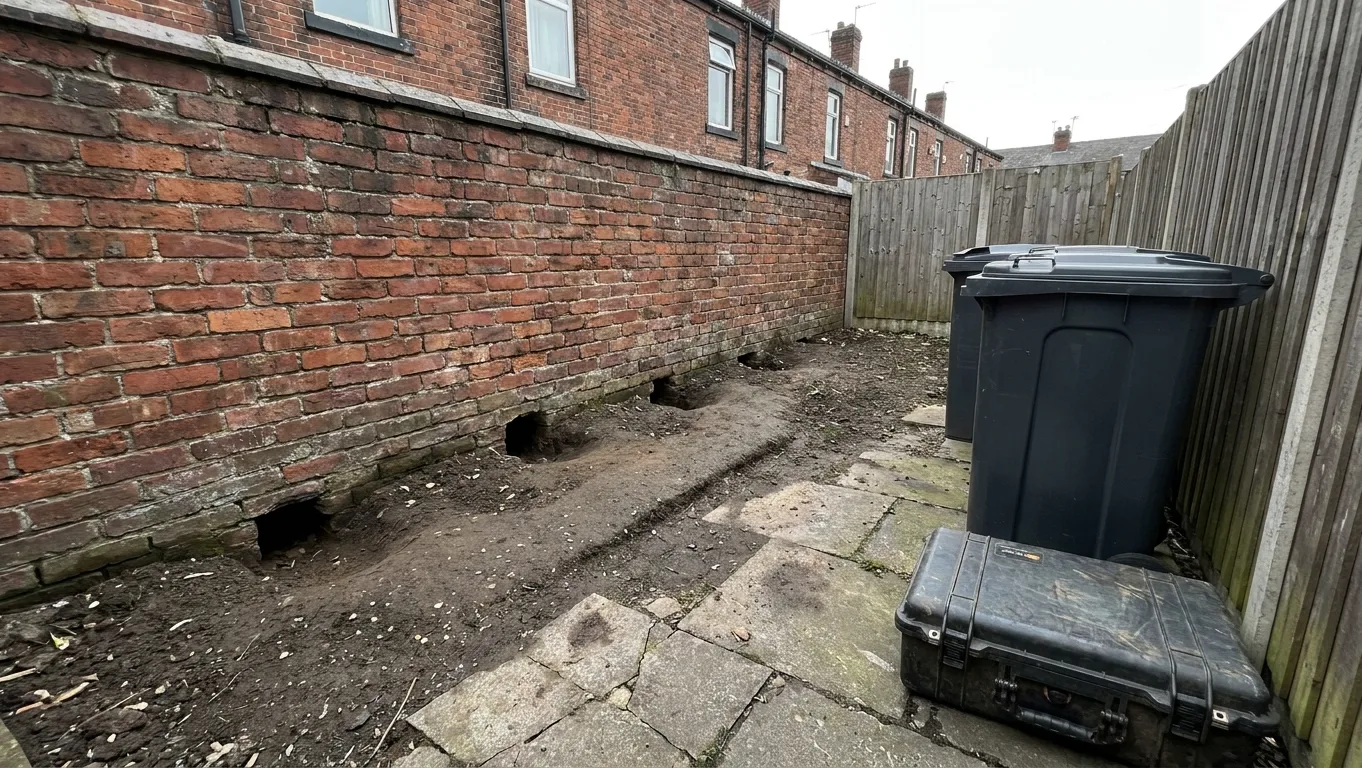
Rats in Union City live in the rear yards, alleys and cellar edges between buildings. We find every active hole and runway on the lot before a single trap goes down.
Sewer-Side Entry Checked
A rat inside with no hole outside usually came up from below — a broken lateral, an open clean-out or a floor drain that has lost its water seal.
A Plan for the Neighbours
Rats forage across property lines. We tell you plainly which part of the problem is on your lot and which part needs the building next door or the city.
Local Rat Removal & Exterminator for Union City Property Owners
We are a pest control company working across the NJ & NYC metro area, and Union City is one of the places we are called to most often. What follows is what we actually know about rat removal & exterminator here — the building types, the conditions that drive it, and the local rules — rather than a page of stock copy with a place name dropped into it.
If something is turning up in your Union City home or business, call (862) 256-6829 for an inspection. You will get an honest read on what is there and a written estimate before anything is scheduled.
Union City, NJ at a Glance
Union City sits in Hudson County at roughly 194 feet above sea level and is home to about 68,589 people. Those numbers matter more than they look: density, elevation and age of the housing stock are the three things that decide which pests a place actually gets.
| Population | 68,589 (2020 Census) |
|---|---|
| County | Hudson County, NJ |
| Elevation | 194 feet above sea level |
| ZIP codes | 07087 |
Population from the 2020 US Census. Elevation, ZIP and founding data via Wikidata.
Pest Pressure in Union City This Week
Today in Union City: Slight Chance Showers And Thunderstorms then Mostly Sunny, around 84°F. A slight chance of showers and thunderstorms before 8am. Mostly sunny, with a high near 84. Northwest wind 5 to 9 mph. Chance of precipitation is 20%. New rainfall amounts less than a tenth of an inch possible.
Tonight 67°F, partly cloudy · Saturday 81°F, sunny · Saturday Night 64°F, partly cloudy
Right now mosquito pressure is high because of mean temperatures around 78°F.
How weather moves rats. Heavy rain is the event to watch: it floods burrows and surcharges sewers, and rats that lose their shelter surface in cellars, yards and drains within a day or two. A hard cold snap pushes more of them toward heated buildings, while long dry spells send them looking for water near hose bibs, drains and pet bowls. The rodent bar above reflects those triggers — it can tell you when pressure is likely to rise, not whether rats are already on your property.
Forecast from the National Weather Service (public domain). Pest pressure is our own index, calculated from temperature, rainfall and humidity. Updated 2026-09-04.
Mice, Rats or Both? Rodent Help in Union City
Mice and rats get in differently, live differently and are dealt with differently, so we run three separate Union City pages. Pick the one that matches what you are finding.
Norway Rat Signs — Burrows, Runways and Droppings
The Norway rat (Rattus norvegicus) is the rat this region has: heavy and blunt-nosed, with a body of up to about 25 centimetres and a slightly shorter scaly tail, living at ground level and below it.
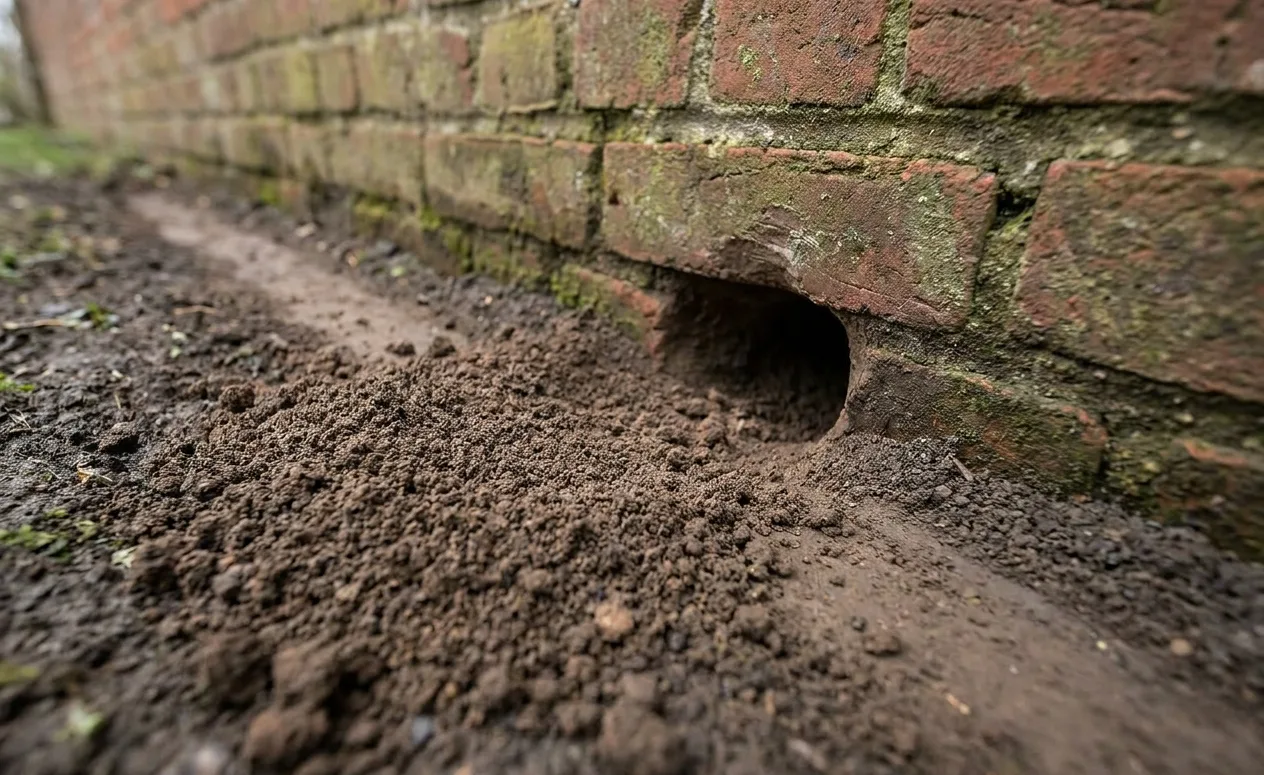
- Burrow entrances. Round holes roughly the width of a tennis ball, with smooth, packed edges and a fan of loose soil thrown out in front. A clean rim with no cobwebs or leaf litter means the hole is in use.
- Runways. Narrow paths worn bare through grass or packed into soil along walls, fences and foundation edges. Rats repeat the same route every night.
- Droppings. Dark, blunt-ended and about the size of a raisin or an olive pit, usually dropped in small clusters along runways and near food.
- Rub marks and gnawing. Dark smudges where fur brushes the same corner again and again, and chewed plastic bins, doors and pipe insulation.
- Sound. Heavier than mice — scrabbling, dragging and gnawing, mostly from dusk into the early morning.
A rat seen in daylight is worth taking seriously. Rats keep to the dark by choice, so daytime activity usually means crowding, a disturbed burrow or a food source they are competing for.
In attached neighbourhoods the first signs are usually in the narrow rear yard: a hole under the concrete pad, a runway along the fence behind the bins, or droppings in the cellar stairwell.
Where Rats Live on a Dense Block
Norway rats need three things within a short walk of each other: soil or rubble to dig in, water, and a reliable meal. Older attached blocks supply all three.
- Rear yards and alleys. Cracked concrete, loose pavers and soil strips along back fences are the classic burrow sites, usually right beside where the rubbish is kept.
- Cellar edges. Deteriorated mortar at the foundation, gaps around old coal chutes and areaway doors, and utility pipes that enter below grade.
- The sewer. Older combined sewer systems carry rats between blocks. A broken house lateral, a missing clean-out cap or a basement floor drain whose trap has dried out gives them a way up inside.
- Food nearby. Overflowing bins, bags left out overnight, restaurant refuse and bird seed thrown for pigeons feed far more rats than any single kitchen.
Because rats forage beyond one lot, the colony in your yard may be feeding two doors down. Success then means your lot sealed and clear, even while pressure continues on the block.
Removing Rats — the Order That Works
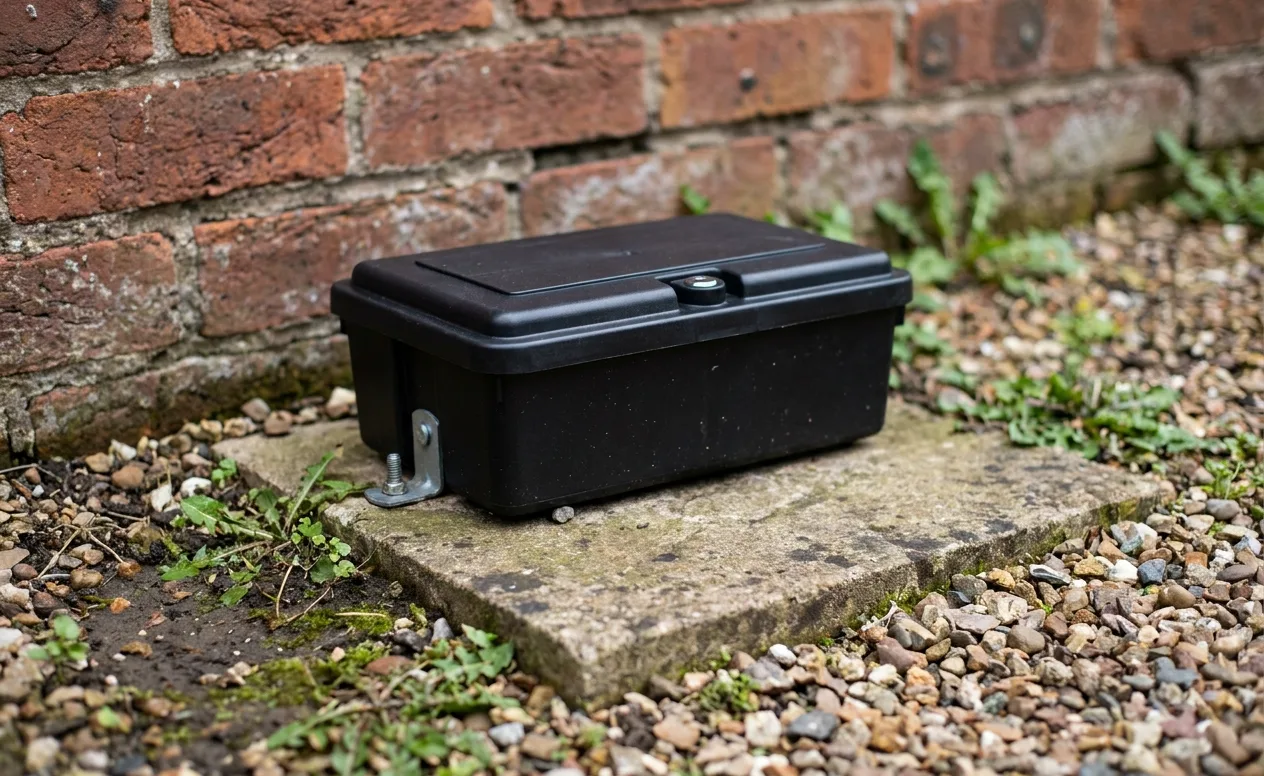
Rats are suspicious of anything new. A trap that appears overnight on a runway is often walked around for days. That caution, called neophobia, is why a rat program starts with pre-baiting: large rat traps go out baited but unset, placed along walls and runways inside covered boxes, and are only armed once the rats are feeding from them freely. Set them too early and the colony learns to avoid them.
Size matters. Mouse traps only injure rats. Rat work uses heavy snap traps or enclosed trap boxes, set perpendicular to the wall with the trigger on the runway, and plenty of them — rats rarely all feed from one spot.
Inside a multi-family building, trapping is the tool; rodenticide in occupied space risks rats dying in wall voids and ceilings between apartments.
Exterior bait stations. Outside, a program usually adds locked, weighted or anchored stations along the foundation and fence lines where runways are active. The strongest rodenticides — the second-generation anticoagulants — have been withdrawn from consumer products in the US and are limited to professional use for exactly this reason: an animal that eats them stays poisonous to the hawks, foxes, cats and dogs that may find it. Stations are checked and logged on every visit, and bait is removed once feeding stops rather than left out indefinitely.
Burrows. After treatment, active holes are packed with soil and checked on the next visit. A hole that has been dug open again is the clearest sign the colony is still there; a hole that stays closed across several visits is the sign it is not.
Dead rats and odour. A rat that dies inside a wall or ceiling produces a strong smell that can last one to three weeks. Flies gathering at one spot on a wall, or a stain on a ceiling, usually points to it. A reachable carcass is removed with gloves, bagged, and the area disinfected — soak droppings and nesting material with disinfectant before wiping, never sweep them up dry. Where it cannot be reached, ventilation and time are often the only option, which is one more reason interior work relies on traps.
What the visits look like.
- First visit: mark every burrow, runway and entry point inside and out; set pre-baited traps and, where needed, exterior stations; note what the rats are eating and drinking.
- Weekly visits: arm traps once feeding is steady, log catches and station feeding, and move equipment to where the activity is.
- Exclusion: seal the gaps the survey found — concrete and hardware cloth at the foundation, door sweeps, vent screens, pipe penetrations.
- Close-out: no fresh burrow openings, no new droppings and no feeding across two or three consecutive visits. That is the finish line, and it should be written down.
Landlords, Tenants and the Town
On a New Jersey rental property, a rat infestation is the owner's to correct as a housing maintenance condition, and in buildings with shared cellars, yards and refuse areas that is almost always the only practical arrangement — no single tenant controls the whole route.
If you rent, tell the owner in writing, with dates and photos of burrows, droppings or damage, and keep a copy. If nothing happens, the local health department or code enforcement office can inspect; buildings registered as multiple dwellings are also subject to state inspection by the Department of Community Affairs.
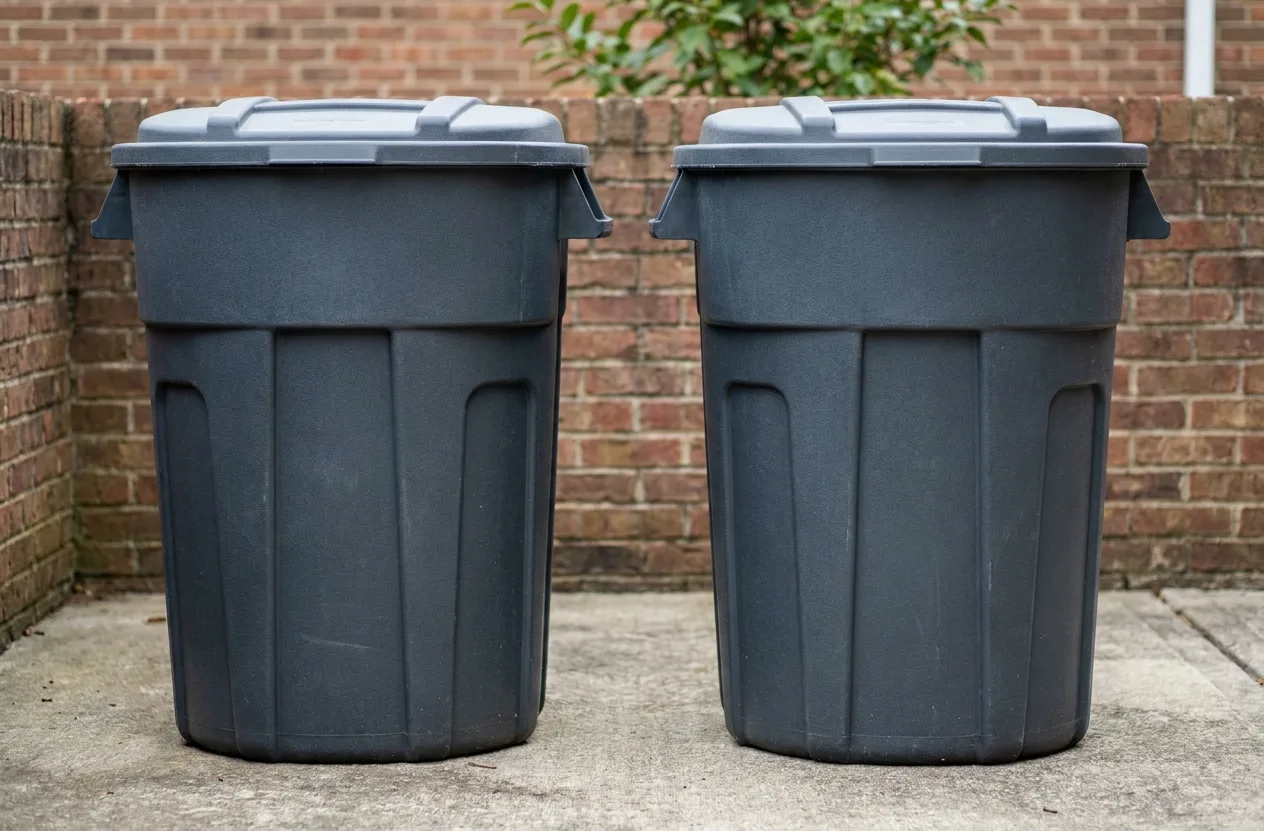
If you own, the refuse area is where money does the most good: lidded metal or heavy plastic bins, a pad that can be hosed down, and a rule that bags never sit on the ground overnight. Many towns also have ordinances on how rubbish must be stored and set out, and on vacant lots and overgrown yards that shelter rats — the municipal code office can tell you what applies on your street.
Why it matters beyond the damage. Rat urine can carry leptospirosis, a bacterial infection spread mainly through contact with the urine of infected animals, and rats contaminate food and food-contact surfaces with salmonella. Norway rats can also carry Seoul virus, a hantavirus, although human cases in this country are rare. Do not handle rats, nests or droppings bare-handed, and treat anything they have touched as dirty until it is cleaned and disinfected.
General information about the rules as written, not legal advice about your situation. Confirm current requirements with the agency named before relying on them.
Rat Removal — Common Questions
We only see them in the yard. Do we need to do anything inside?
Check the cellar before deciding. Rats in a rear yard often have a way into the basement through the foundation, an areaway door or a floor drain, and droppings on the cellar stairs are an early warning worth looking for.
The traps have been out for three days and caught nothing. Is it working?
That is normal at the start. Rats are wary of new objects, so traps are left unset and baited while the colony gets used to them. The catches come after they are armed, and the first week is about acceptance, not numbers.
There is a smell in the wall after treatment. What now?
Tell us where it is strongest. If the carcass can be reached through an access panel or a small opening, it can be removed and the area disinfected. If it cannot, the smell usually fades within one to three weeks with good ventilation.
Pest Pressure in Union City, NJ
Union City is the densest municipality in New Jersey and among the densest in the country — roughly 68,000 people in about 1.3 square miles, stacked on the slope of the Hudson Palisades. Density on that scale changes the arithmetic of pest control completely. Buildings share walls in continuous runs down whole blocks, so a German cockroach or bed bug population is effectively living in a single structure that happens to have many addresses.
Bergenline Avenue runs the length of the city and is one of the longest continuous commercial corridors in the state, with hundreds of restaurants, bakeries, groceries and small food businesses backing onto residential blocks. That corridor is the single largest driver of rodent pressure in Union City, and it operates at block scale rather than property scale.
The Palisades grade matters too. Steep east-west streets mean stormwater moves fast and collects at the bottom of the slope, and retaining walls, stepped foundations and rock outcrops give Norway rats burrow harborage that no amount of interior work will touch. The blocks along Summit Avenue, Palisade Avenue, Central Avenue and New York Avenue each read slightly differently depending on where they sit on that slope.
The city falls almost entirely within ZIP 07087.
What Union City Buildings Are Made Of
Union City's stock is overwhelmingly pre-war multi-family: three-, four- and six-storey walk-ups and converted tenements built shoulder to shoulder, many dating to the embroidery-industry boom of the early twentieth century. Party walls are continuous, air shafts are shared, and the plumbing risers that serve stacked kitchens and bathrooms run in common chases from cellar to roof.
Those risers are the critical detail. In building after building the escutcheon plates around pipe penetrations are missing or were never fitted, leaving an open annular gap at every floor. That gap is a vertical highway — German cockroaches, mice and bed bugs all use it, and it is why treating a single apartment in a Union City walk-up almost never holds. Sealing riser penetrations is usually the highest-value hour of work in the entire building.
Cellars are typically low, shared, and used for storage and utilities, which gives American cockroach and Norway rat a base of operations underneath the whole structure.
The Calls We Get Most in Union City
German cockroach in a stacked line of apartments. The most common serious call in the city. Units 2R, 3R and 4R all have it because they share a kitchen riser. Treating one is money spent on a delay.
Bed bugs moving between adjoining apartments. Same route, same reason — wall voids, outlet boxes and the riser chase. A single-unit treatment in an attached building is rarely the end of it.
Rats behind Bergenline food businesses. Rear yards and shared bin areas serving multiple storefronts. Burrows are usually in the adjoining residential yard rather than on the commercial property, which is why the restaurant's own exterminator never seems to fix it.
Mice in a top-floor apartment. Counter-intuitive but common — mice travel up the riser chase and nest in the top-floor ceiling void where it is warmest and quietest.
American cockroach in the cellar and first-floor units. Floor drains and the building's connection to an old sewer lateral.
Local Rules and Who to Call in Union City
Union City runs its own health department, and pest conditions in rental housing are handled as property maintenance matters through the city. The stronger route for tenants in larger buildings is the state one: any building of five or more units is registered under the Hotel and Multiple Dwelling Law and inspected on a cycle by the New Jersey Department of Community Affairs, Bureau of Housing Inspection. Given how much of Union City's housing sits in buildings above that threshold, this applies to a large share of the city's tenants. Report the condition to the owner in writing first and keep the copy — a documented, ignored complaint is what turns an inspection into a finding.
Areas We Cover in Union City
- Bergenline Avenue corridor
- Summit Avenue
- Palisade Avenue
- Central Avenue
- New York Avenue
- West Street
- Kennedy Boulevard
- Transfer Station area
ZIP 07087 covers effectively the whole city.
Union City — Local Questions
My apartment was treated for roaches and they came back within a month. Why?
In a Union City walk-up, almost always because the apartments above and below share a kitchen or bathroom riser with yours and were not treated. The population lives in the chase between the units, not in your kitchen. The treatments that hold here are line-wide or building-wide, with the riser penetrations sealed as part of the job.
The rats are coming from the restaurant behind us. Whose problem is it?
Usually both. The food source is commercial but the burrows are very often in the adjoining residential yard, which is why treating only the business fails. Report it to the city health department so the whole rear-yard area is looked at rather than one property, and expect a lasting fix to involve refuse handling on the commercial side and burrow work on the residential side.
Rat Removal & Exterminator Near Union City
We cover the surrounding towns from the same base, so if you are just outside Union City the nearest service pages are below.
- Rat Removal & Exterminator in Hoboken, NJ 2 mi
- Rat Removal & Exterminator in West New York, NJ 2 mi
- Rat Removal & Exterminator in North Bergen, NJ 2 mi
- Rat Removal & Exterminator in Manhattan, NY 3 mi
- Rat Removal & Exterminator in Kearny, NJ 5 mi
In Union City we also handle rodent control, mouse control, and general pest control. Our main service pages cover rodent control, cockroach control and bed bug extermination.
📍 On the map
Holes Along the Fence Line?
Fresh burrows and worn runways mean rats are living on the lot now. Book a free estimate before the colony grows.
Call About RatsHow Rat Removal Runs in Union City
From the first burrow found to a quiet yard, in four steps
Rat work is patient work, because rats are wary of change. Here is how a Union City rat job unfolds from the first visit to the last.