
Termite Treatment Near Me in Hoboken, NJ
Subterranean termite inspection, soil treatment and baiting for Hoboken homes and buildings. Free estimate, written scope.


Porches, Sills and Shared Walls
In attached Hoboken housing termites reach the frame through porch posts, stoops and the sill plate on the party wall. We inspect the whole line, not just the room with the wings.
Soil Treatment or Baiting
A liquid barrier works fast where the soil along the foundation can be reached. Baiting suits tight lots and slabs you cannot drill. We explain which fits your building.
Moisture Found First
Leaking downspouts, damp basements and wood touching soil are what draw termites in. The written report names them, so the treatment is not undone by the next storm.
Local Termite Treatment for Hoboken Property Owners
We are a pest control company working across the NJ & NYC metro area, and Hoboken is one of the places we are called to most often. What follows is what we actually know about termite treatment here — the building types, the conditions that drive it, and the local rules — rather than a page of stock copy with a place name dropped into it.
If something is turning up in your Hoboken home or business, call (862) 256-6829 for an inspection. You will get an honest read on what is there and a written estimate before anything is scheduled.
Hoboken, NJ at a Glance
Hoboken sits in Hudson County at roughly 26 feet above sea level, was first settled around 1849 and is home to about 60,419 people. Those numbers matter more than they look: density, elevation and age of the housing stock are the three things that decide which pests a place actually gets.
| Population | 60,419 (2020 Census) |
|---|---|
| County | Hudson County, NJ |
| Elevation | 26 feet above sea level |
| Founded | 1849 |
| ZIP codes | 07030 |
Population from the 2020 US Census. Elevation, ZIP and founding data via Wikidata.
Pest Pressure in Hoboken This Week
Today in Hoboken: Slight Chance Showers And Thunderstorms then Mostly Sunny, around 85°F. A slight chance of showers and thunderstorms before 8am. Mostly sunny. High near 85, with temperatures falling to around 83 in the afternoon. Northwest wind 5 to 9 mph. Chance of precipitation is 20%. New rainfall amounts less than a tenth of an inch possible.
Tonight 68°F, partly cloudy · Saturday 81°F, sunny · Saturday Night 64°F, partly cloudy
Right now mosquito pressure is high because of mean temperatures around 78°F; general pest pressure is moderate because of daytime temperatures in the foraging range.
How weather drives termites. Swarming is the one weather-timed event: Eastern subterranean termites typically swarm on warm days after rain between March and May, which is when the swarm row appears in the panel above. The feeding colony is a different matter — it works in the soil and inside wood through most of the year, slowing in cold ground but not stopping, and in heated basements it can stay active all winter. A quiet panel means no swarm is likely this week, not that there are no termites.
Forecast from the National Weather Service (public domain). Pest pressure is our own index, calculated from temperature, rainfall and humidity. Updated 2026-09-04.
Is It Termites? Swarmers, Tubes and Damaged Wood
The termite in this part of New Jersey is the Eastern subterranean termite (Reticulitermes flavipes). It nests in the soil, not in the house, and reaches wood through earthen tubes or direct contact. Formosan termites are not established here, and drywood termites are a southern and western problem — if anyone mentions either, ask what they saw.
Swarmer or flying ant? Three features settle it:
- Wings. A termite swarmer has two pairs of wings of equal length, extending well beyond the body and shed within hours. A winged ant's front wings are clearly longer than its hind wings.
- Waist. Termites are broad-waisted, almost tubular. Ants are pinched sharply between thorax and abdomen.
- Antennae. Termite antennae are straight and beaded. Ant antennae are elbowed.
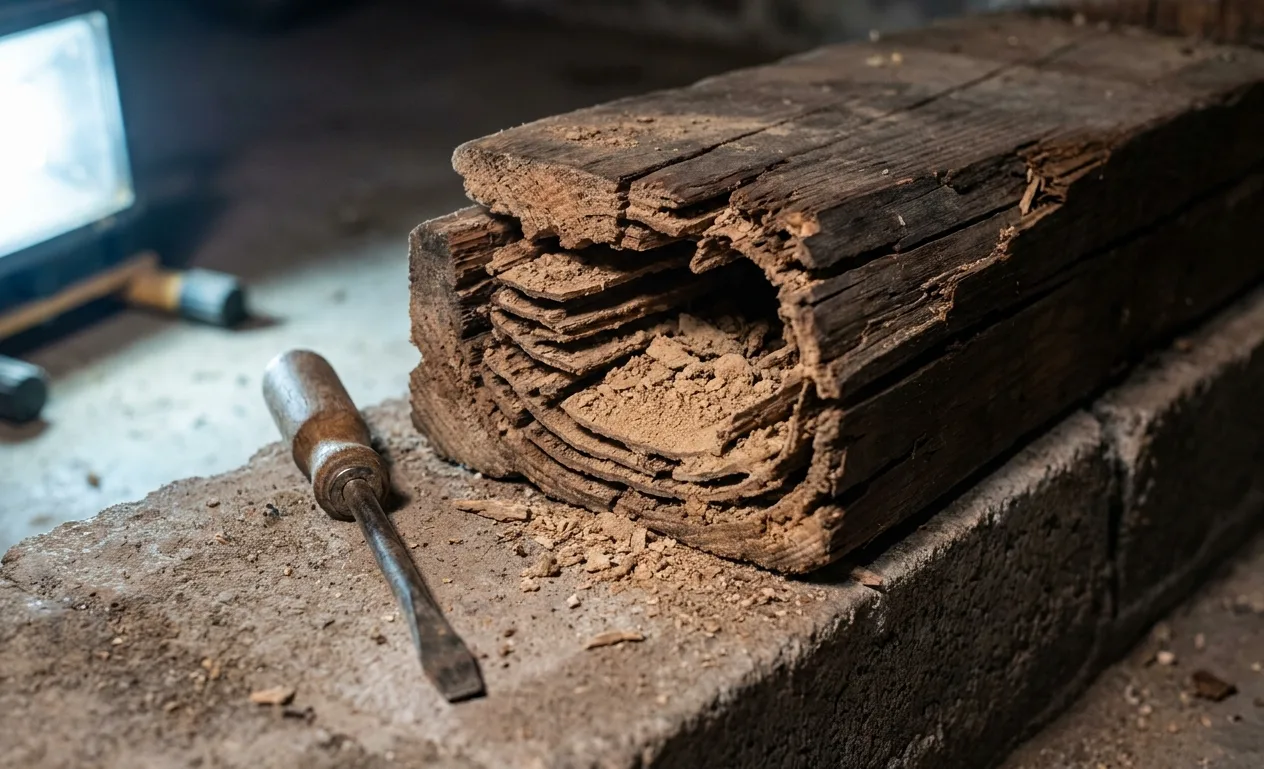
The evidence left behind is usually more useful than the insects. Shed wings in piles on sills and basement floors. Mud tubes, pencil-width earthen runways up a foundation wall, a pier or a pipe, which workers build because they dry out in open air. And damaged wood: termites eat the softer springwood and leave the harder bands, so the galleries follow the grain and are packed with soil and faecal material. Hollow-sounding wood or blistered paint on a sill is worth probing.
The common look-alike is the carpenter ant (Camponotus pennsylvanicus). It nests in wood rather than eating it, so its galleries are clean and smooth, with coarse frass of shavings and insect parts pushed out. Soil in the galleries means termites; clean galleries and a sawdust pile mean ants and, nearly always, a moisture problem.
Where Termites Get Into Older Attached Housing
Subterranean termites need soil moisture, so they enter at or below grade. In Hoboken's older wood-frame two-families and row houses the entry points are predictable.
- Porches and stoops. Wooden porch posts set on or in the soil, and concrete stoops poured over fill against the house, are the most common entry we find. The fill under a stoop stays damp and hides the tubes.
- The sill plate and party wall. Where the timber sill sits close to grade, or where a shared wall runs into a damp cellar, termites can travel along it. In attached rows a colony does not respect the property line.
- Cellar floors and wood in contact with soil. Wooden posts on a dirt or cracked concrete floor, stair stringers resting on the slab, old form boards left in place, and storage timber on the ground.
- Leaks and poor drainage. A downspout discharging against the foundation, a failed gutter, or a rear yard that drains toward the house keeps the soil at the wall wet — exactly what a colony wants.
- Finished basements, where panelling hides tubes for years.
Heated cellars near boilers keep colonies active later into autumn and occasionally produce swarmers indoors in late winter.
Soil Treatment, Baiting and What Order to Do It In
On a narrow attached lot the method is usually decided by access. A side passage of bare soil can be trenched; a front stoop, a paved rear yard and a concrete cellar floor have to be drilled; a building where drilling is impractical may be better served by baiting.
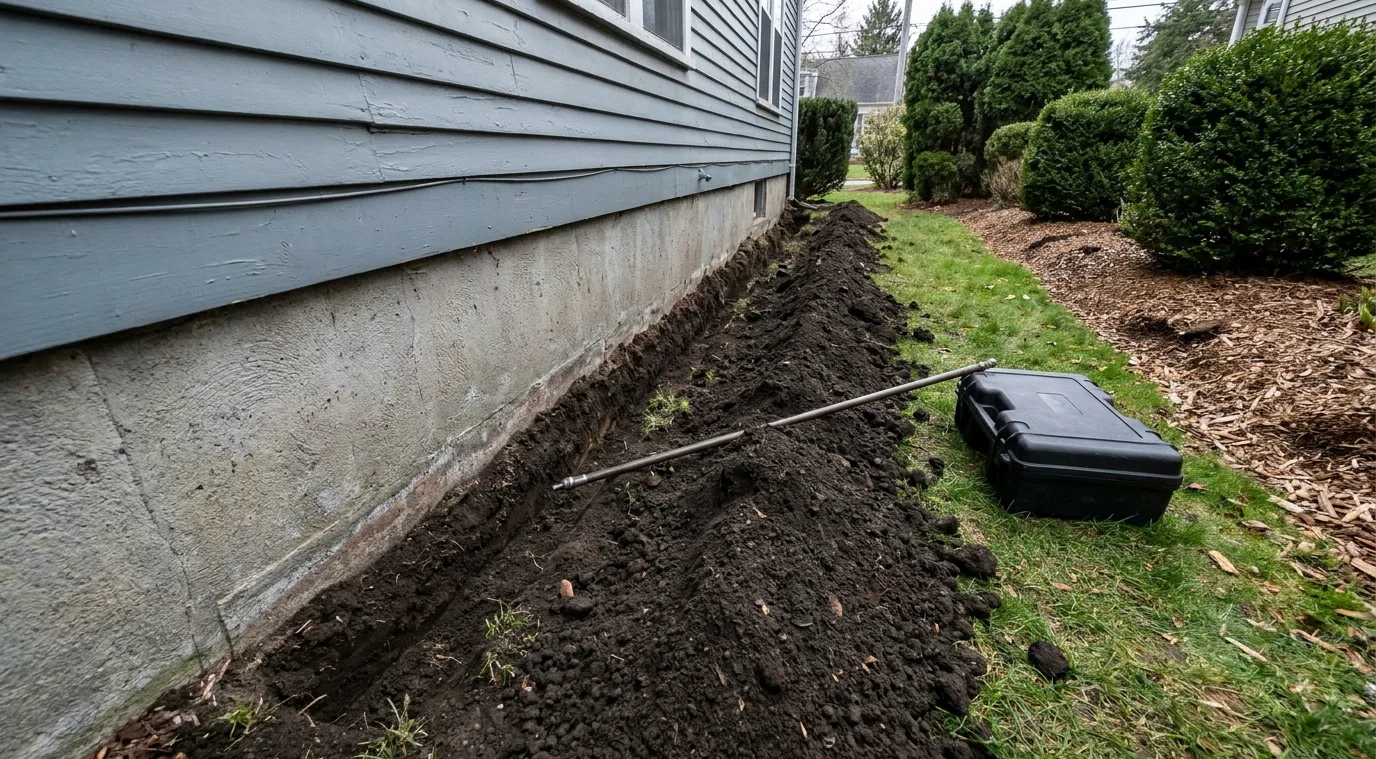
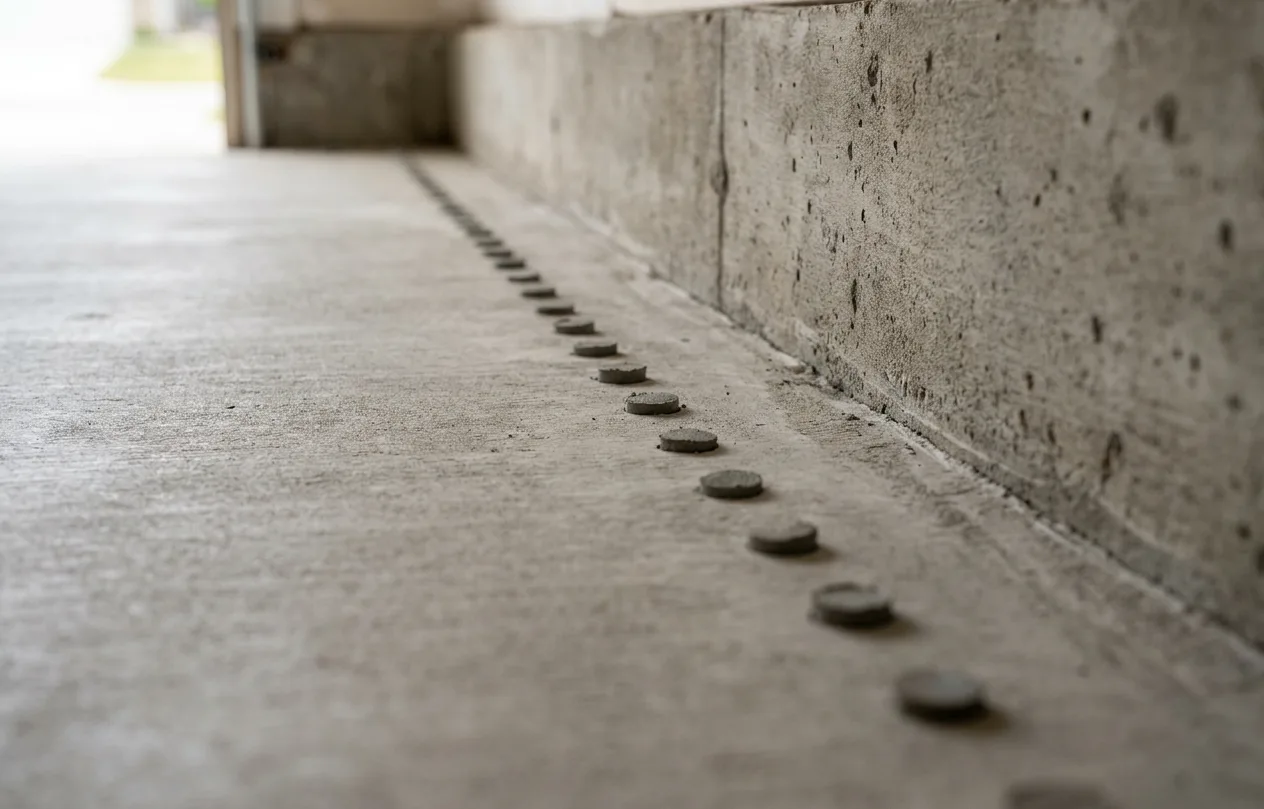
Liquid soil treatment puts a continuous treated zone where termites travel to reach the building: a narrow trench along open foundation, with rodding below it toward the footing, and drilling at close intervals through slabs, porches and cellar floors, which are then patched. Volume is the whole game, applied to the product label.
Non-repellent or repellent. Non-repellents — fipronil, imidacloprid, chlorantraniliprole — cannot be detected, so workers pass through, pick up a dose and carry it back. Repellent pyrethroids such as bifenthrin form a barrier the insects avoid, which only holds if it has no gaps.
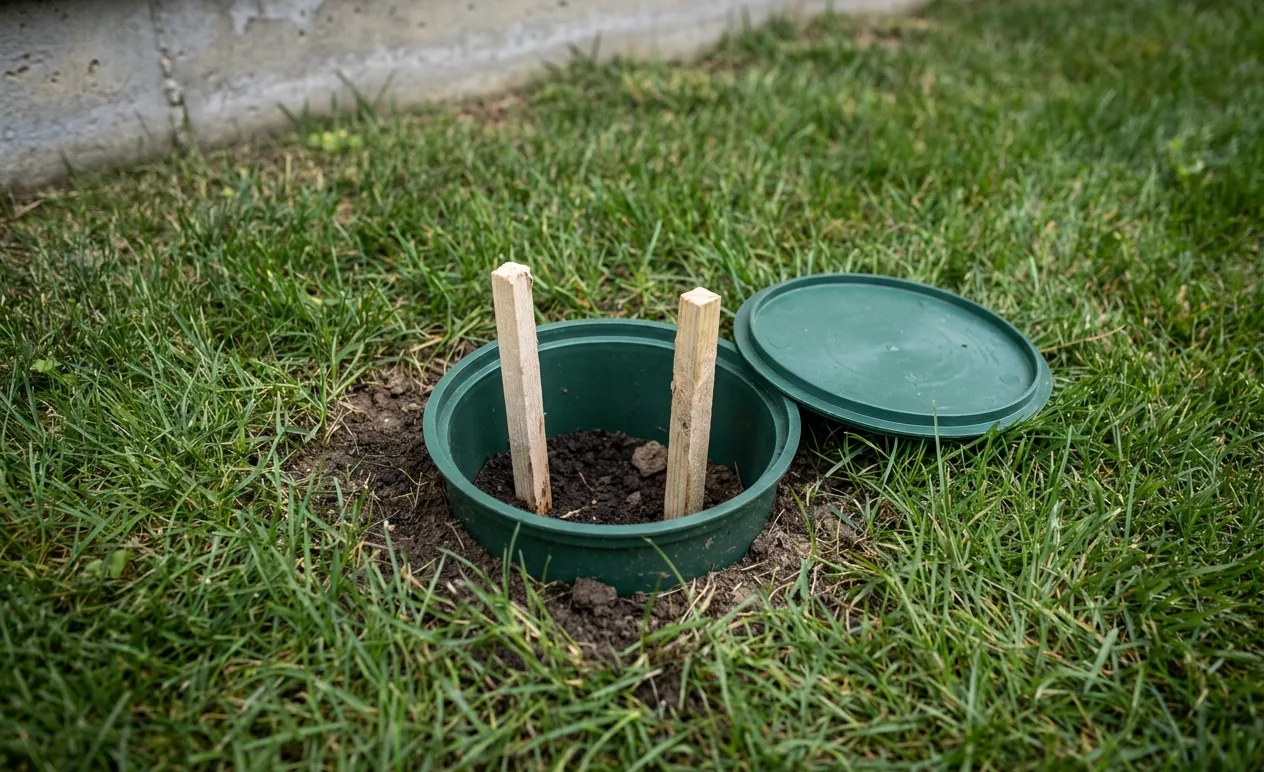
Baiting systems work the other way round. Monitoring stations go into the soil around the building and are checked on a schedule; once termites are feeding, a cellulose bait with a chitin synthesis inhibitor (noviflumuron, hexaflumuron) goes in, which stops workers moulting. The colony declines over months. Slower, but it targets the colony and needs no drilling.
Spot treatments and borates. Foam injected into an active gallery kills the termites in that wood, not the colony in the soil. Borate (disodium octaborate tetrahydrate) on bare, unfinished wood protects that timber — ideal when joists and sills are exposed during renovation — but does nothing to the soil.
Why do-it-yourself products fail. Spraying a visible tube kills a handful of workers while the colony, foraging over tens of metres of soil, builds another. Consumer products cannot reach the depth and volume a foundation needs. Breaking a tube and watching whether it is rebuilt is useful diagnosis, not treatment.
Correct the conditions at the same time. Pull soil and mulch back from the siding, redirect downspouts, get wood off the cellar floor, and fix leaks. Treatment addresses the termites; the conditions decide whether they come back.
Rentals, Shared Walls and Who Is Responsible
Termite damage is a structural condition, so in rented housing it is ordinarily the owner's responsibility, not the tenant's. If you rent and see swarmers or tubes, tell the landlord in writing, with the date and a photo, and keep a copy. Damage to joists, sills and porch structure is a property maintenance matter, and municipal code enforcement is the route if nothing is done. In registered multiple dwellings, the state Bureau of Housing Inspection is a second route.
For owners of attached buildings, the practical issue is the neighbour: a colony under a row ignores the property line, so treating one house while the next has active tubes on the shared foundation leaves a live source metres away. A written report is a better opening to that conversation than a guess.
The NPMA-33 report. The Wood Destroying Insect Inspection Report is the standard form used in real estate transactions here, routinely requested by buyers and lenders. It records whether visible evidence of termites and other wood-destroying insects was found, where, and whether there is visible damage. Two things it is not: it is not a warranty that the building is free of termites, and it is not a structural assessment. It is a visual snapshot of the accessible areas on the day. Finished walls, stored contents and floor coverings hide evidence; read the section listing what could not be inspected.
What a thorough termite estimate includes: where activity was found; the conducive conditions to correct; the method and why it suits this building; the product class; how often bait stations are checked, if baiting; and re-inspection and re-service terms in writing. Ask for the applicator's certification for termite work — in New Jersey termites and wood-destroying insects are their own certification category (7B).
General information about the rules as written, not legal advice about your situation. Confirm current requirements with the agency named before relying on them.
Termite Treatment — Common Questions
We found wings on the windowsill but no insects. Is that termites?
Possibly. Termite swarmers shed their wings within hours, so a pile of equal-length wings is often the only trace. Keep a few in a sealed bag or photograph them against a ruler, and look for mud tubes on the foundation wall below that window, inside and out. Winged ants leave wings too, but their front and hind wings differ in length.
Can termites spread from next door?
The colony lives in the soil and forages in whatever direction the food and moisture are, so in attached housing one colony can reach several buildings. That is why the inspection covers the shared foundation line, not just your side of it.
Do we have to leave during treatment?
Generally not for exterior soil treatment or baiting. Interior drilling of a cellar floor is noisy and dusty for a few hours, and you will be told which areas to clear and keep people and pets away from until applications have dried.
Pest Pressure in Hoboken, NJ
Hoboken is a square mile of former tidal marsh and made ground between the Palisades and the Hudson, and its two defining pest drivers are both consequences of that. The first is water. The western and southwestern parts of the city sit in a natural bowl below the surrounding grade, on a combined sewer system that surcharges in heavy rain. When it does, American cockroaches and Norway rats come up through floor drains and cellar entries, and the ground-floor and garden-level units feel it first. The city's resiliency parks and detention systems have improved the street flooding considerably, but the sewer geometry underneath has not changed.
The second is food density. Washington Street and the blocks either side carry one of the highest concentrations of bars and restaurants anywhere in New Jersey, most of them in buildings with no rear service access, so refuse goes to the kerb. That is a nightly food supply along a continuous corridor, and it sets rat pressure for the surrounding residential blocks regardless of how clean any individual brownstone is.
Conditions differ by section: Southwest Hoboken and the area around the terminal for flooding, Uptown and Midtown for the older attached stock, Castle Point for the rock ledge, and the Waterfront for newer construction. All of it is ZIP 07030.
What Hoboken Buildings Are Made Of
Hoboken's housing is dominated by attached pre-war stock: brownstones, brick row houses and four- to six-storey walk-ups built lot-line to lot-line, most of them subdivided into apartments. Party walls run continuously for the length of a block, cellars are shared or adjoining, and stacked kitchens and bathrooms are served by common plumbing risers running cellar to roof.
The riser chase is the detail that decides most outcomes here. Missing escutcheon plates around pipe penetrations leave an open gap at every floor, and German cockroaches, mice and bed bugs all use it. A single-apartment treatment in a Hoboken walk-up frequently fails for exactly this reason.
Then there are the conversions — former factories and warehouses turned into lofts, with large open volumes, exposed structure and utility runs that were never designed to be sealed. And along the waterfront, modern mid- and high-rise buildings where the pest routes are trash rooms, compactor chutes, loading bays and structured parking rather than cellars and party walls.
Garden-level and ground-floor units across all of these are the most exposed, because they sit closest to the sewer and to the kerb.
The Calls We Get Most in Hoboken
Water bugs in a garden-level apartment after heavy rain. American cockroach up a floor drain or cellar entry, tracking the sewer rather than the apartment.
German cockroach in a stacked line of a walk-up. Same units on consecutive floors, sharing a kitchen riser. Building-line treatment is the version that holds.
Rats in the rear yards behind Washington Street. Kerbside restaurant refuse feeding burrows in adjoining residential yards, planters and under decking. A block-level problem.
Mice in a top-floor apartment in autumn. Up the riser chase into the warm ceiling void, noticed as overnight lows fall through the 50s.
Bed bugs in a building with high turnover. A lot of Hoboken's stock is rented to a population that moves often, and every move is an opportunity for introduction and for spread into the adjoining unit.
Mosquitoes on a rooftop deck. Almost always breeding on the roof itself — a clogged roof drain, a planter saucer, a cover on a grill.
Local Rules and Who to Call in Hoboken
Hoboken has its own health department, and property maintenance and refuse issues run through the city. Because so much of the housing sits in buildings of five units or more, the state route matters here: those buildings are registered under New Jersey's Hotel and Multiple Dwelling Law and inspected on a cycle by the New Jersey Department of Community Affairs, Bureau of Housing Inspection. Report the condition to the owner or managing agent in writing and keep the copy — in a city where a great deal of the stock is owner-absent and professionally managed, a written and ignored complaint is what converts a complaint into a finding. For buildings of four units or fewer, municipal code enforcement is the route.
Areas We Cover in Hoboken
- Downtown
- Southwest Hoboken
- Uptown
- Midtown
- Castle Point
- The Waterfront
- Church Square
- Washington Street corridor
ZIP 07030 covers the entire city.
Hoboken — Local Questions
Every time it rains hard we get water bugs downstairs. Is that our building?
Usually not the building itself. Hoboken's combined sewer carries stormwater and sewage together, and in heavy rain the lines surcharge and push American cockroaches up through floor drains, particularly where a trap has dried out. Keeping traps primed, fitting proper drain covers and sealing cellar entry gaps solves more of this than any interior treatment does.
We're on the fourth floor. How are we getting mice?
Through the plumbing riser chase. In Hoboken's attached walk-ups the pipes serving stacked kitchens and bathrooms run in a common chase from cellar to roof, and the gaps at each floor are usually open because the escutcheon plates are missing. Mice travel it vertically and often nest in the top-floor ceiling void because it is the warmest and quietest part of the building.
Termite Treatment Near Hoboken
We cover the surrounding towns from the same base, so if you are just outside Hoboken the nearest service pages are below.
- Termite Treatment in Union City, NJ 2 mi
- Termite Treatment in Manhattan, NY 2 mi
- Termite Treatment in West New York, NJ 3 mi
- Termite Treatment in North Bergen, NJ 3 mi
- Termite Treatment in Kearny, NJ 5 mi
In Hoboken we also handle pest control, rodent control, bed bug treatment, cockroach control, and mosquito control. Our main service pages cover cockroach control, termite treatment and mosquito control.
📍 On the map
Found Wings on a Windowsill?
Shed wings or mud tubes on the foundation are worth a look before the damage is. Free estimate, written scope.
Call About TermitesHow Termite Treatment Runs in Hoboken
Four stages, from the first sign to the monitored barrier
Termite work is slow and structural, and the order matters. This is the sequence a Hoboken job follows.