
Termite Treatment in Bronx, NY
Subterranean termite inspection, soil treatment and baiting for Bronx homes and buildings. Free estimate, written scope.


Frame and Brownstone Interiors
Wood-frame houses and the timber joists inside masonry row houses are where termites turn up in Bronx. We look where the wood meets soil, fill or a damp cellar floor.
Soil Treatment or Baiting
Drilling a cellar slab, rodding a narrow side yard or setting bait stations where there is no soil to trench. The method follows the building, not the other way round.
Written Findings for Owners and Boards
A dated report naming locations, damage and conducive conditions — the record an owner, board or buyer needs before a decision is made.
Local Termite Treatment for Bronx Property Owners
We are a pest control company working across Bronx County, and Bronx is one of the places we are called to most often. What follows is what we actually know about termite treatment here — the building types, the conditions that drive it, and the local rules — rather than a page of stock copy with a place name dropped into it.
If something is turning up in your Bronx home or business, call (862) 256-6829 for an inspection. You will get an honest read on what is there and a written estimate before anything is scheduled.
Bronx, NY at a Glance
Bronx sits in Bronx County at roughly 295 feet above sea level, was first settled around 1898 and is home to about 1,472,654 people. Those numbers matter more than they look: density, elevation and age of the housing stock are the three things that decide which pests a place actually gets.
| Population | 1,472,654 (2020 Census) |
|---|---|
| County | Bronx County, NY |
| Elevation | 295 feet above sea level |
| Founded | 1898 |
| ZIP codes | 10451, 10452, 10453, 10454, 10455, 10456, 10457, 10458, 10459, 10460, 10461, 10462, 10463, 10464 and others |
Population from the 2020 US Census. Elevation, ZIP and founding data via Wikidata.
Pest Pressure in Bronx This Week
Today in Bronx: Slight Chance Showers And Thunderstorms then Mostly Sunny, around 85°F. A slight chance of showers and thunderstorms before 8am. Mostly sunny. High near 85, with temperatures falling to around 83 in the afternoon. Northwest wind 5 to 9 mph. Chance of precipitation is 20%. New rainfall amounts less than a tenth of an inch possible.
Tonight 66°F, partly cloudy · Saturday 80°F, sunny · Saturday Night 63°F, isolated rain showers
Right now mosquito pressure is high because of mean temperatures around 78°F.
How weather drives termites. Swarming is the one weather-timed event: Eastern subterranean termites typically swarm on warm days after rain between March and May, which is when the swarm row appears in the panel above. The feeding colony is a different matter — it works in the soil and inside wood through most of the year, slowing in cold ground but not stopping, and in heated basements it can stay active all winter. A quiet panel means no swarm is likely this week, not that there are no termites.
Forecast from the National Weather Service (public domain). Pest pressure is our own index, calculated from temperature, rainfall and humidity. Updated 2026-09-04.
Termites in New York City — Where They Actually Turn Up
People are often surprised that New York City has termites at all. It does: the Eastern subterranean termite (Reticulitermes flavipes) is found across the city wherever wood meets damp soil. Formosan termites are not established here, and drywood termites are not a New York problem.
Honestly assessed, risk varies enormously by building. Wood-frame detached and semi-attached houses — common in Staten Island, Queens, much of Brooklyn and parts of the Bronx — carry real risk. Brownstones and masonry row houses have timber joists, cellar stairs and posts inside the masonry shell, and that is where we find damage. Masonry high-rises are low risk, though not zero where wood meets a damp cellar floor; a swarm in a high-rise lobby is far more often ants.
Swarmer or flying ant? Three features settle it:
- Wings. A termite swarmer has two pairs of wings of equal length, extending well beyond the body and shed within hours. A winged ant's front wings are clearly longer than its hind wings.
- Waist. Termites are broad-waisted, almost tubular. Ants are pinched sharply between thorax and abdomen.
- Antennae. Termite antennae are straight and beaded. Ant antennae are elbowed.
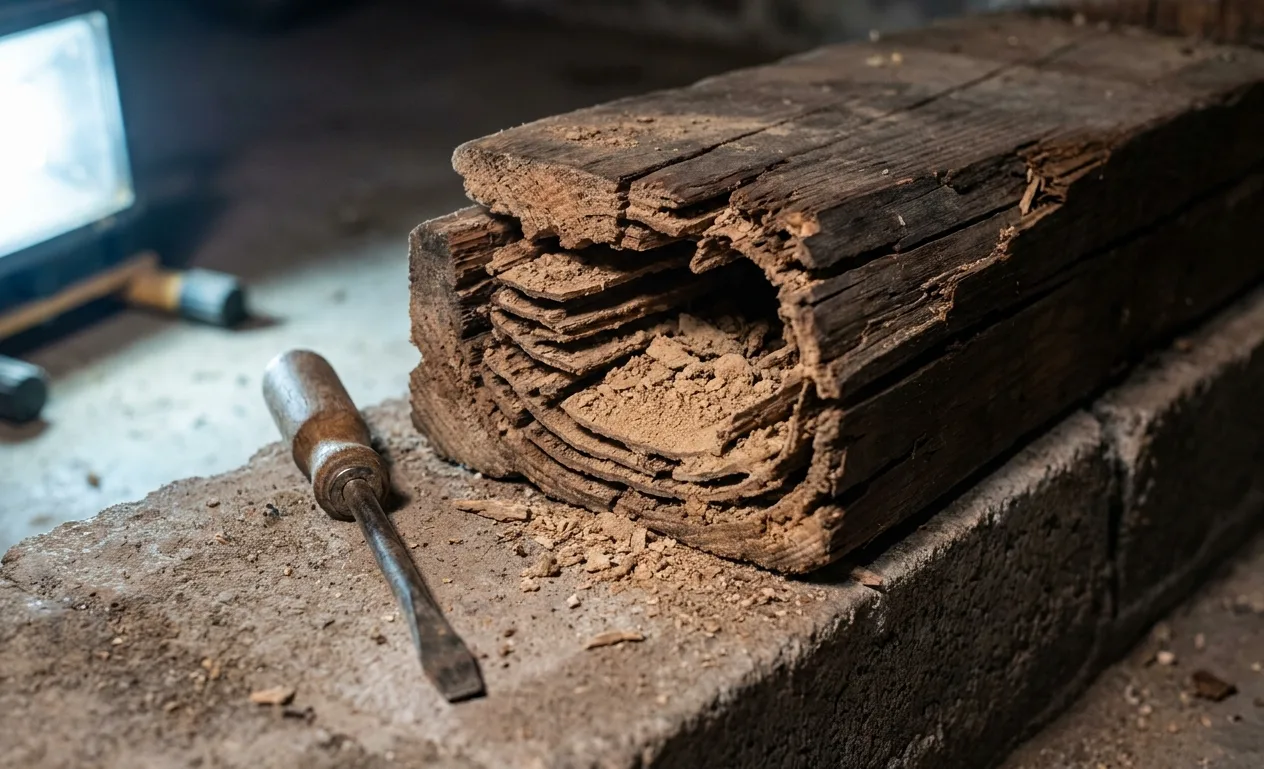
The evidence left behind is usually more useful than the insects. Shed wings in piles on sills and basement floors. Mud tubes, pencil-width earthen runways up a foundation wall, a pier or a pipe, which workers build because they dry out in open air. And damaged wood: termites eat the softer springwood and leave the harder bands, so the galleries follow the grain and are packed with soil and faecal material. Hollow-sounding wood or blistered paint on a sill is worth probing.
The common look-alike is the carpenter ant (Camponotus pennsylvanicus). It nests in wood rather than eating it, so its galleries are clean and smooth, with coarse frass of shavings and insect parts pushed out. Soil in the galleries means termites; clean galleries and a sawdust pile mean ants and, nearly always, a moisture problem.
Where Termites Get Into City Buildings
Subterranean termites enter from the soil, so the work is at and below grade — usually in the cellar and the yard, not the rooms where people notice wings.
- Cellar floors and wood on concrete. Old cellars often have wooden posts, stair stringers, partitions and shelving resting directly on a cracked slab or a dirt floor. Cracks and the joint where the floor meets the wall are the route up.
- Joist ends in masonry walls. In brownstones and older row houses the joists sit in pockets in damp foundation and party walls. A persistent leak there makes the joist ends attractive and hard to see.
- Stoops, areaways and rear extensions. Fill under stoops, wooden areaway steps, and rear additions on slabs joined to an older foundation.
- Yards and planting beds. Soil and mulch piled against a frame house, wooden fences and decks against the building, and old stumps or buried wood in the yard.
- Water. Leaking leaders, backed-up yard drains and plumbing leaks in the cellar keep the soil and wood damp. Warm boiler rooms extend the season.
In attached rows one colony forages under several buildings.
Treatment Options in a City Building
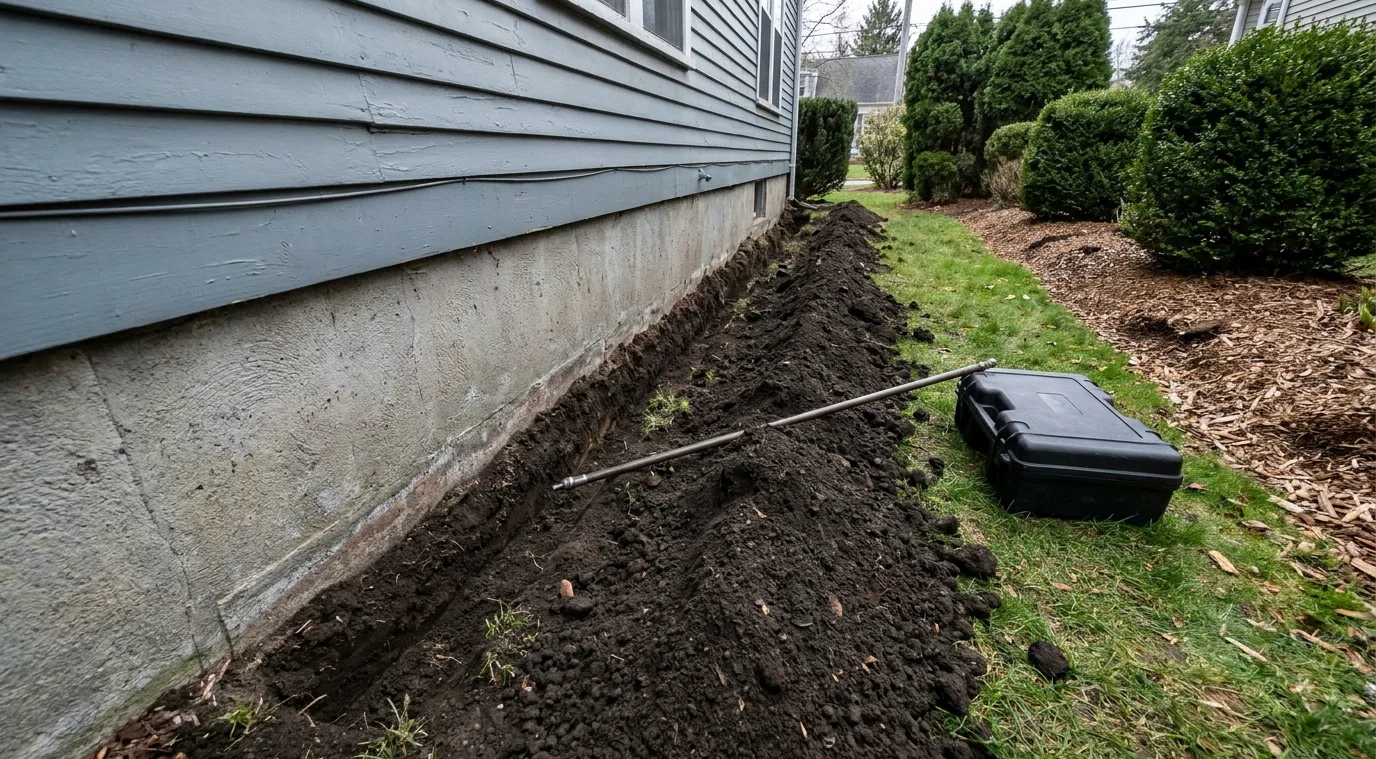
City buildings rarely offer a clean run of open soil around the foundation, so treatment is usually a combination: drilling the cellar slab along the foundation and around penetrations, treating whatever soil is accessible in yards and planting strips, and baiting where drilling is impractical.
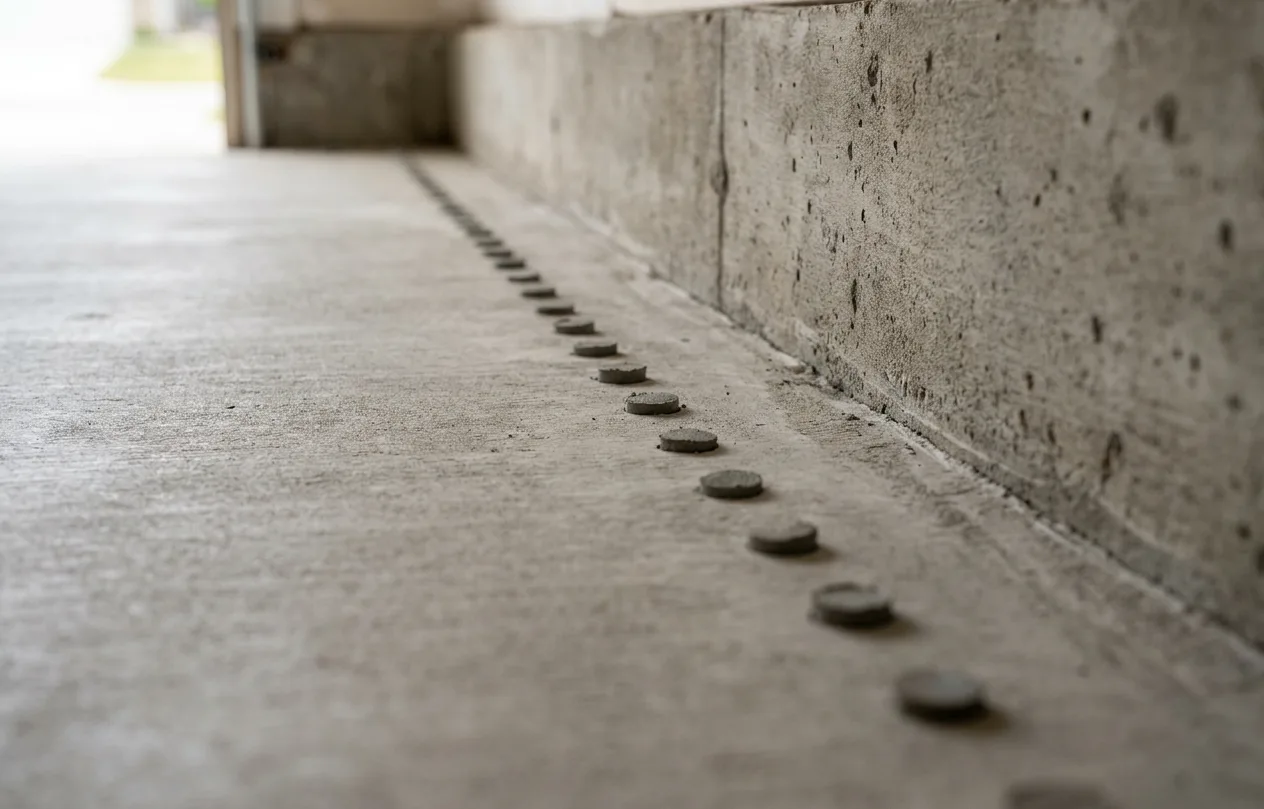
Liquid soil treatment puts a continuous treated zone where termites travel to reach the building: a narrow trench along open foundation, with rodding below it toward the footing, and drilling at close intervals through slabs, porches and cellar floors, which are then patched. Volume is the whole game, applied to the product label.
Non-repellent or repellent. Non-repellents — fipronil, imidacloprid, chlorantraniliprole — cannot be detected, so workers pass through, pick up a dose and carry it back. Repellent pyrethroids such as bifenthrin form a barrier the insects avoid, which only holds if it has no gaps.
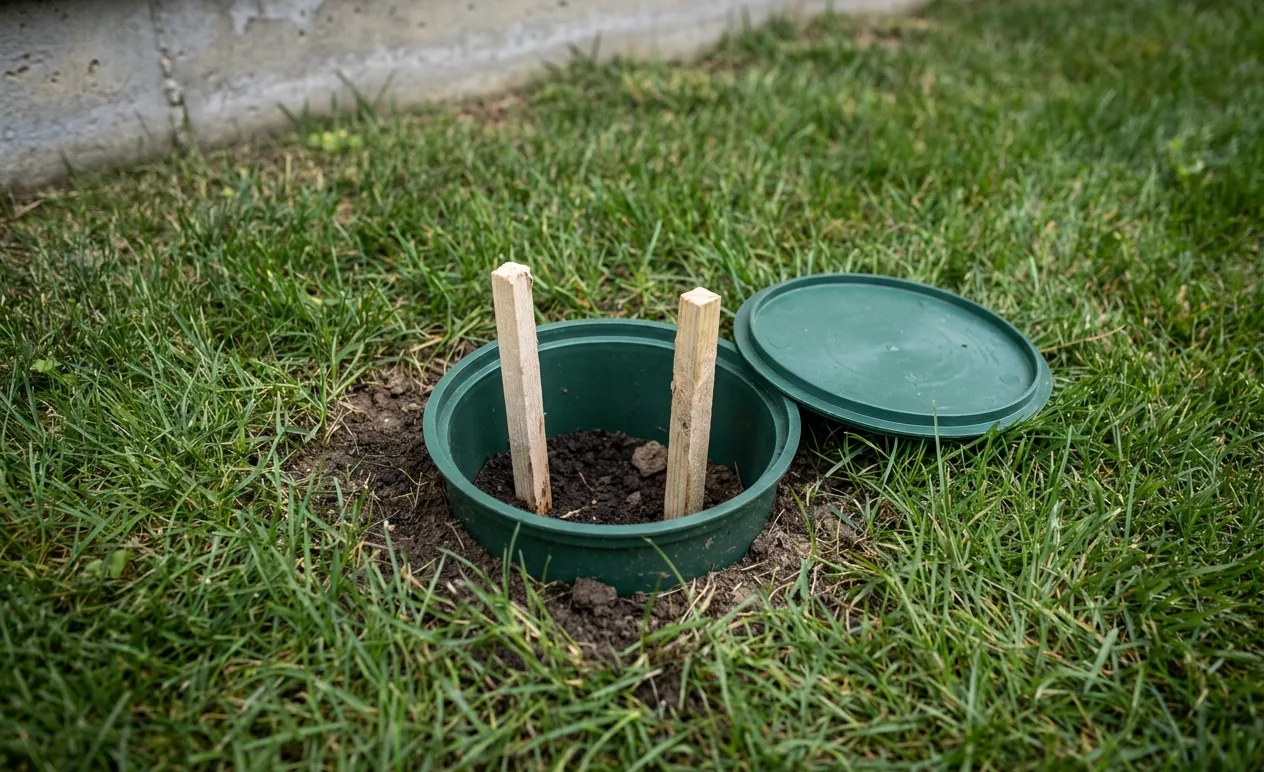
Baiting systems work the other way round. Monitoring stations go into the soil around the building and are checked on a schedule; once termites are feeding, a cellulose bait with a chitin synthesis inhibitor (noviflumuron, hexaflumuron) goes in, which stops workers moulting. The colony declines over months. Slower, but it targets the colony and needs no drilling.
Spot treatments and borates. Foam injected into an active gallery kills the termites in that wood, not the colony in the soil. Borate (disodium octaborate tetrahydrate) on bare, unfinished wood protects that timber — ideal when joists and sills are exposed during renovation — but does nothing to the soil.
Why do-it-yourself products fail. Spraying a visible tube kills a handful of workers while the colony, foraging over tens of metres of soil, builds another. Consumer products cannot reach the depth and volume a foundation needs. Breaking a tube and watching whether it is rebuilt is useful diagnosis, not treatment.
Treatment stops termites; it does not restore a weakened joist. Damaged load-bearing members need a contractor or engineer, and the report gives them the locations.
Responsibility, Records and Selling in New York City
If you rent, termite damage to floors, stairs, joists and other structure is a building condition, and the Housing Maintenance Code places the duty to keep a multiple dwelling in good repair on the owner. Report it to the owner in writing with photos and keep a copy. If it is not addressed, a 311 complaint to HPD is the route for conditions in the building. Termites are not among the pests named in the indoor allergen hazard law, so do not expect that law to be the lever here — the repair obligation is.
For co-op and condo boards, cellars, foundations and structure are common elements. A dated written report naming locations, damage and conducive conditions turns a complaint into a budgeted decision, and it is what an engineer or buyer will ask for later.
The NPMA-33 report. The Wood Destroying Insect Inspection Report is the standard form used in real estate transactions here, routinely requested by buyers and lenders. It records whether visible evidence of termites and other wood-destroying insects was found, where, and whether there is visible damage. Two things it is not: it is not a warranty that the building is free of termites, and it is not a structural assessment. It is a visual snapshot of the accessible areas on the day. Finished walls, stored contents and floor coverings hide evidence; read the section listing what could not be inspected.
Ask for the applicator's New York State certification before any treatment is carried out.
General information about the rules as written, not legal advice about your situation. Confirm current requirements with the agency named before relying on them.
Termite Treatment — Common Questions
Winged insects appeared in our apartment in spring. Termites?
In an upper-floor apartment of a masonry building, more likely ants — but check. Look at the wings (equal length for termites), the waist (broad) and the antennae (straight). If they are termites, the source is at ground level, so tell the owner or managing agent: the cellar is where the inspection needs to happen.
Our brownstone has a finished cellar. Can termites still be there?
Yes. Joists in masonry pockets, wooden stairs and framing on the slab are all reachable, and finishes hide the tubes. An inspection covers the accessible areas and reports the ones it could not see, which in a finished cellar will be a real limitation.
Does treatment mean drilling through our cellar floor?
Often, yes, along the foundation walls and around penetrations, with the holes patched afterwards. Where drilling is impractical, bait stations placed in accessible soil are the alternative.
Pest Pressure in Bronx, NY
The Bronx combines two things that no other borough has together at this scale: an enormous concentration of large pre-war apartment buildings, and the Hunts Point Food Distribution Center — one of the largest wholesale food markets in the world, moving produce, meat and fish continuously on a site served by rail and truck around the clock.
Hunts Point is a rodent factor unlike anything else in the region. Food volume on that scale, with rail alignment, truck yards and industrial land around it, sustains a Norway rat population that pushes outward into the surrounding neighbourhoods regardless of what any individual building does.
The Grand Concourse corridor is a designated Rat Mitigation Zone, reflecting pressure set at neighbourhood scale in a district of very large, very old apartment buildings. Mott Haven, Fordham, Morrisania and Soundview carry the densest housing. The borough also has the most parkland in the city — Pelham Bay Park, Van Cortlandt Park and the Bronx Park corridor — which brings wooded-edge conditions, ticks and wildlife into play in a way the other dense boroughs do not have.
Riverdale, Throgs Neck, Country Club and Morris Park have detached and semi-detached single-family housing with yards. Bronx ZIP codes run across 104xx.
What Bronx Buildings Are Made Of
The characteristic Bronx building is the large pre-war apartment block — five and six storeys, often Art Deco along the Grand Concourse, built around courtyards, with long horizontal corridors, shared basements and stacked kitchens and bathrooms on common plumbing risers running cellar to roof.
Scale is what makes these different from a Manhattan walk-up. A single building may hold a hundred apartments, so a population has both vertical routes through the riser chases and horizontal routes along corridors and through the basement. Missing escutcheon plates at riser penetrations are close to universal in this stock, and they are the reason unit-by-unit treatment in a Bronx apartment building is close to futile.
There is also a very large amount of public and subsidised housing, where treatment is coordinated at development scale and the practical issue is getting access to every affected unit in a line on the same day.
Cellars are below grade with floor drains on old laterals — American cockroach whenever the sewer surcharges — and compactor chutes in the larger buildings breed drain and phorid flies in the film on the chute wall.
The detached housing in Riverdale, Throgs Neck and Country Club brings the suburban list: attached garages, crawlspaces, attic wildlife, and termites where planting has built up against foundations.
The Calls We Get Most in Bronx
German cockroach across a whole line or wing of a large apartment building. Vertical through risers and horizontal along corridors.
Rats in neighbourhoods around Hunts Point and the rail corridors. Off-property harborage and food at industrial scale.
Rats along the Grand Concourse. Neighbourhood-scale pressure inside a designated mitigation zone.
Mice through riser chases and corridors, nesting on upper floors.
Bed bugs moving between adjoining and stacked units in the large buildings.
Compactor and chute flies. Biofilm inside the chute rather than flies from outside.
Ticks and attic wildlife on properties bordering Pelham Bay, Van Cortlandt and the Bronx Park corridor.
Local Rules and Who to Call in Bronx
Pests in a Bronx multiple dwelling are the owner's responsibility. Report in writing, keep the copy, and file a 311 complaint if it is not corrected so HPD inspects and records the violation. The indoor allergen hazard law requires owners to inspect for cockroaches, mice and rats annually and at unit turnover, to remediate using integrated pest management, and to fix the underlying conditions — which in this housing stock means sealing riser penetrations and correcting refuse handling, not spraying corridors every month.
In a designated Rat Mitigation Zone such as the Grand Concourse, reporting feeds into coordinated neighbourhood inspection and abatement rather than being handled address by address, so it is worth doing even when the burrows are not on your own property. Refuse containerization is the other lever: a building still putting loose bags out overnight is feeding the block, and that is separately reportable.
For independent background, Cornell University's New York State Integrated Pest Management program publishes a guide to termites in New York, including where they feed and how to spot mud tubes.
Areas We Cover in Bronx
- Grand Concourse
- Mott Haven
- Fordham
- Morrisania
- Soundview
- Hunts Point
- Riverdale
- Throgs Neck
- Country Club
- Morris Park
- Pelham Bay
- Kingsbridge
ZIPs across 104xx.
Bronx — Local Questions
Our building sprays the hallways every month and we still have roaches in the apartments. Why?
Because hallway spraying does almost nothing for German cockroach. They live in kitchens and bathrooms and travel the plumbing riser chases between apartments, not the corridors, and repellent spray actively pushes them deeper into those voids and away from bait. What this stock needs is gel bait and a growth regulator applied inside the affected units on a line, with the riser penetrations sealed. If the managing agent is on a monthly corridor spray contract, that is a cost without a result.
The rats seem to come from blocks away. Is there any point treating our building?
Yes, but change what you are treating for. Where the harborage and food are at industrial scale — around Hunts Point, the rail corridors, or inside a Rat Mitigation Zone — you are not going to eliminate the population from one address. The return comes from exclusion: sealing the building so what is outside stays outside, closing gaps at grade, door sweeps, and cellar and drain work. Combine that with 311 reporting so the neighbourhood-scale abatement can work the sources you cannot reach.
Termite Treatment Near Bronx
We cover the surrounding towns from the same base, so if you are just outside Bronx the nearest service pages are below.
- Termite Treatment in Fort Lee, NJ 5 mi
- Termite Treatment in Mount Vernon, NY 5 mi
- Termite Treatment in New Rochelle, NY 6 mi
- Termite Treatment in Yonkers, NY 7 mi
- Termite Treatment in Teaneck, NJ 8 mi
In Bronx we also handle pest control, rodent control, bed bug treatment, cockroach control, and mosquito control. Our main service pages cover cockroach control, termite treatment and mosquito control.
📍 On the map
Found Wings on a Windowsill?
Shed wings or mud tubes on the foundation are worth a look before the damage is. Free estimate, written scope.
Call About TermitesHow Termite Treatment Runs in Bronx
Four stages, from the first sign to the monitored barrier
Termite work is slow and structural, and the order matters. This is the sequence a Bronx job follows.