
Mosquito Control in Garfield, NJ
Breeding-site inspection, larviciding and targeted yard treatment for Garfield homes and businesses. Free estimate, written scope.


Gutters, Tarps and Pool Covers
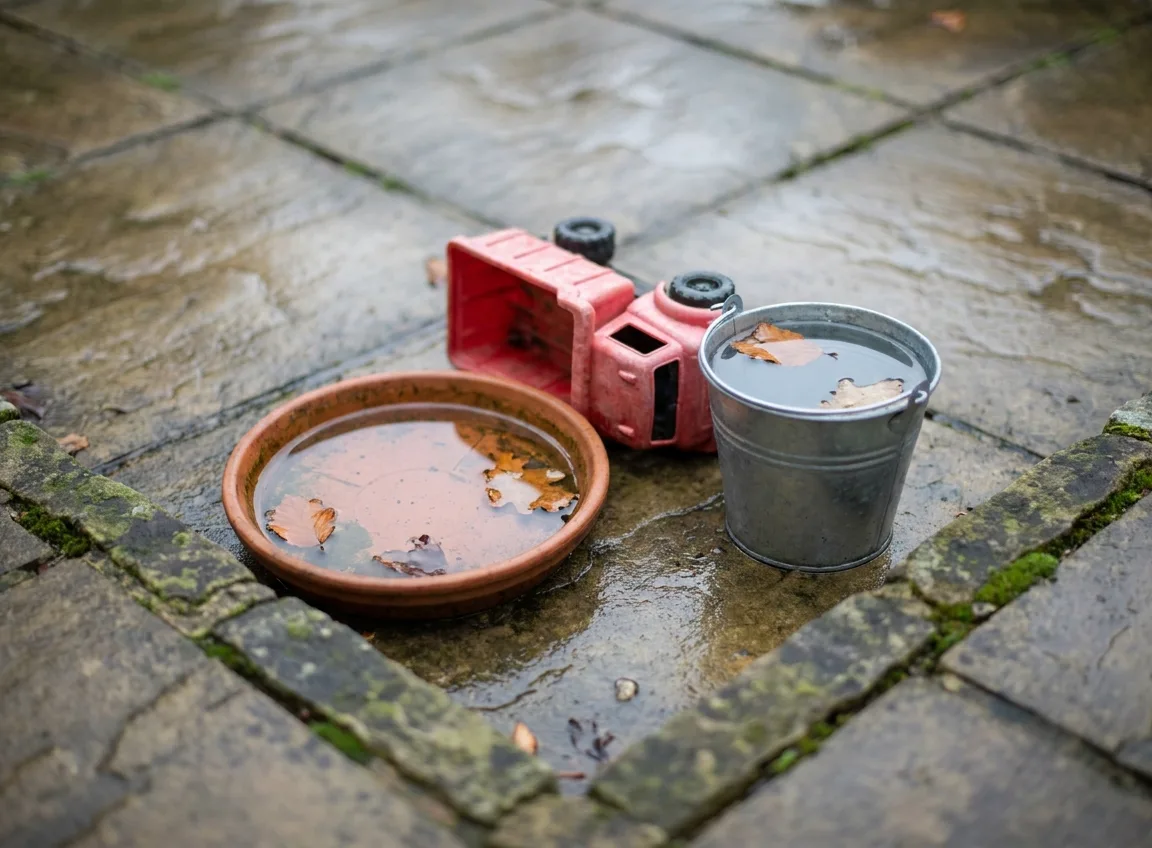
The breeding sites in Garfield yards are predictable: blocked gutters, downspout extensions, tarps, pool covers and anything that holds a cupful of rain.
Targeted Barrier Treatment
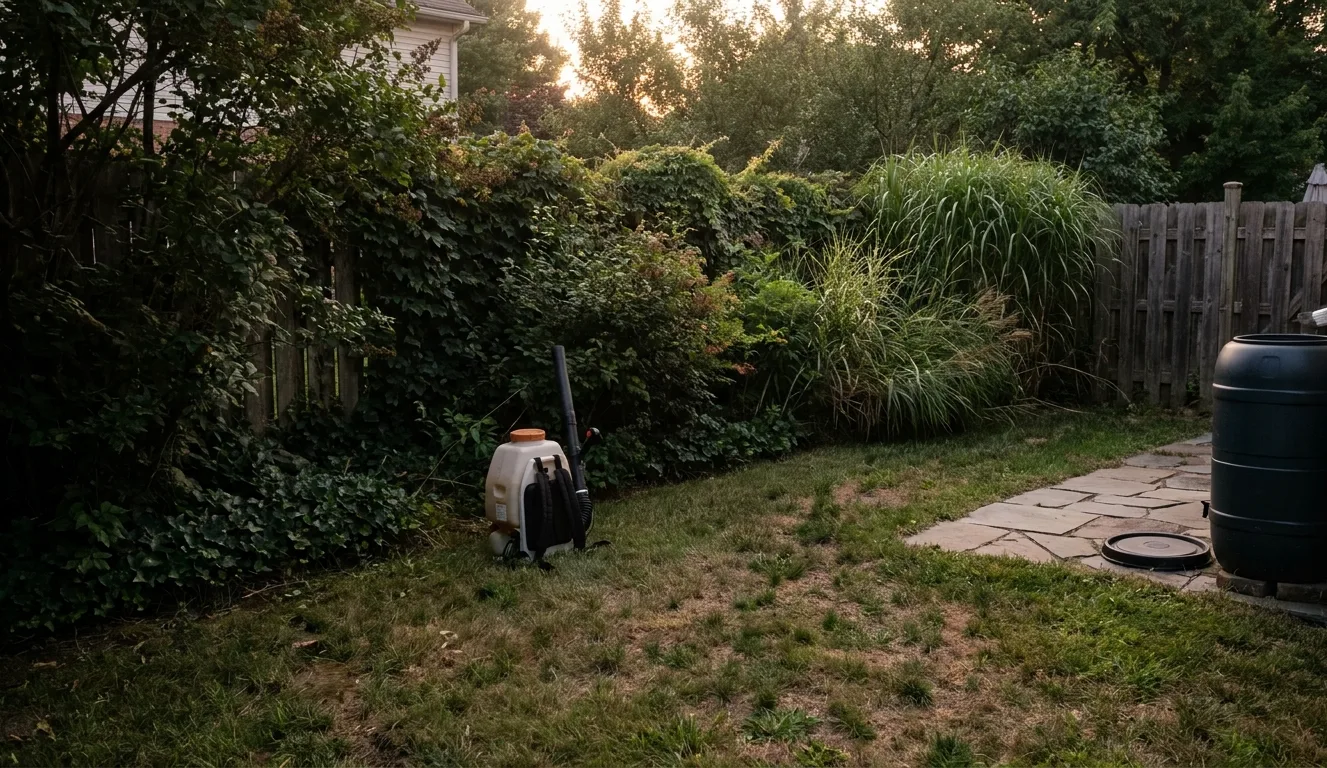
Shaded resting vegetation treated on a schedule, with flowering plants, ponds and water edges left alone to protect pollinators and aquatic life.
Wooded-Edge Yards
Tree holes, leaf-choked drainage and the shaded boundary with woodland hold adults through the day. We treat where they rest, not the open lawn.
Local Mosquito Control for Garfield Property Owners
We are a pest control company working across Bergen County, and Garfield is one of the places we are called to most often. What follows is what we actually know about mosquito control here — the building types, the conditions that drive it, and the local rules — rather than a page of stock copy with a place name dropped into it.
If something is turning up in your Garfield home or business, call (862) 256-6829 for an inspection. You will get an honest read on what is there and a written estimate before anything is scheduled.
Garfield, NJ at a Glance
Garfield sits in Bergen County at roughly 98 feet above sea level and is home to about 32,655 people. Those numbers matter more than they look: density, elevation and age of the housing stock are the three things that decide which pests a place actually gets.
| Population | 32,655 (2020 Census) |
|---|---|
| County | Bergen County, NJ |
| Elevation | 98 feet above sea level |
| ZIP codes | 07026 |
Population from the 2020 US Census. Elevation, ZIP and founding data via Wikidata.
Pest Pressure in Garfield This Week
Today in Garfield: Slight Chance Showers And Thunderstorms then Mostly Sunny, around 84°F. A slight chance of showers and thunderstorms before 8am. Mostly sunny, with a high near 84. Northwest wind 3 to 8 mph. Chance of precipitation is 20%. New rainfall amounts less than a tenth of an inch possible.
Tonight 65°F, partly cloudy · Saturday 80°F, sunny · Saturday Night 62°F, partly cloudy
Right now mosquito pressure is high because of mean temperatures around 77°F; general pest pressure is moderate because of daytime temperatures in the foraging range.
How to read the mosquito row. Mosquito development effectively stops below a mean temperature of about 50°F, so the index starts from temperature and rises with rain in the last few days and humidity above 70%. Rain matters with a delay: containers refilled today produce biting adults about a week from now in summer heat. The season does not end on a date — it ends with the first hard frost, and until then a warm spell in October can bring biting straight back.
Forecast from the National Weather Service (public domain). Pest pressure is our own index, calculated from temperature, rainfall and humidity. Updated 2026-09-04.
Which Mosquito Is Biting You — and Why It Matters
Suburban yards see more species than the dense towns, but two still account for most of the biting, and they need different responses.
Asian tiger mosquito (Aedes albopictus). Small, black, white-banded legs, one white stripe down the back. It bites in daylight and goes for ankles, and it breeds in containers — saucers, buckets, tarps, blocked gutters, tyres, a bottle cap of water. It rarely flies more than a couple of hundred metres, which is the most useful fact about it: if tiger mosquitoes are biting you, they almost certainly hatched on your property or the one next door.
Northern house mosquito (Culex pipiens). Plain brown, bites from dusk through the night — the one you hear in the bedroom. It breeds in organic water: storm-drain catch basins, clogged drains, neglected pools. Because it feeds on birds as well as people, it is the main carrier of West Nile virus in the north-east. Mated females overwinter in sheltered spaces, which is why one can turn up in a cellar in January.
Asian bush mosquito (Aedes japonicus) is common on wooded lots, breeding in tree holes, rock hollows and containers and biting in shade through the day. Near tidal marsh and the Hackensack Meadowlands, salt-marsh mosquitoes (Aedes sollicitans) arrive in bursts after high tides and heavy rain, flying several miles from where they emerge — a county marsh matter rather than a yard one.
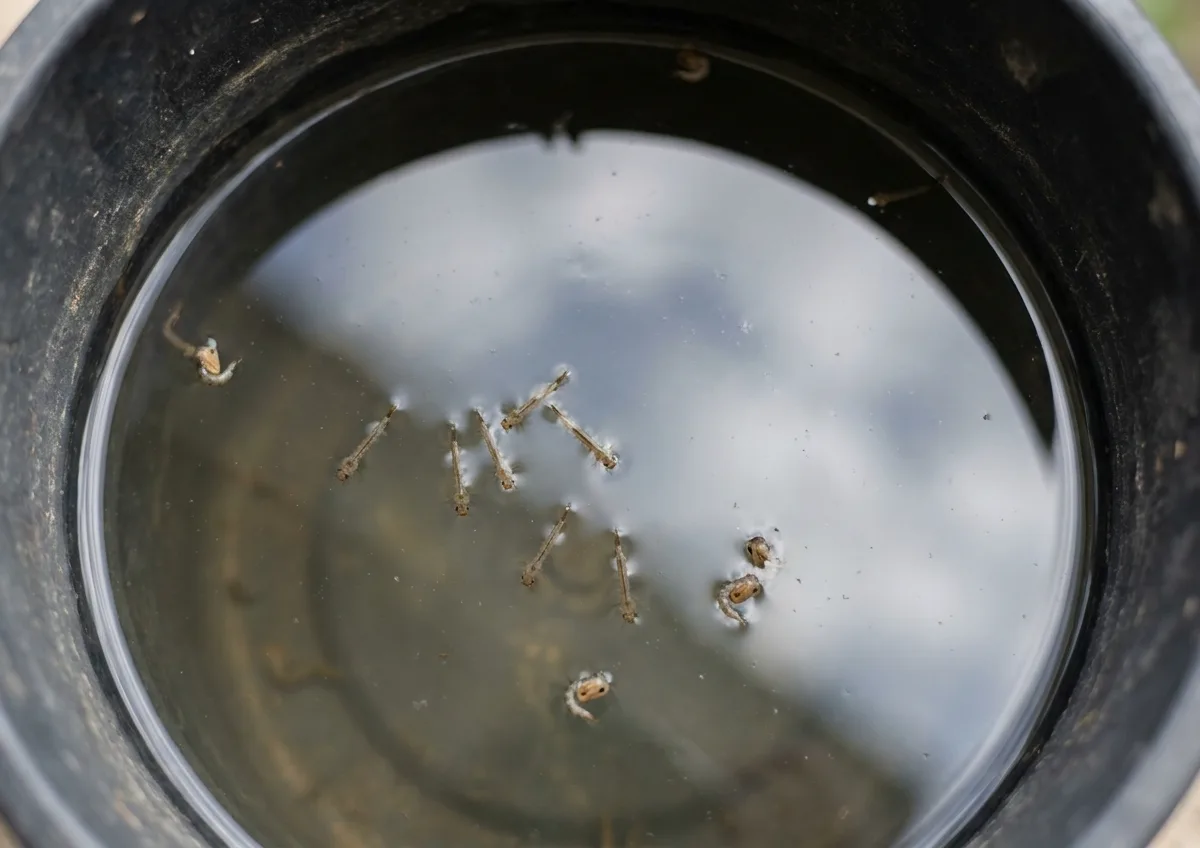
Egg to biting adult takes about a week in summer heat. Aedes eggs sit dry on the inside wall of a container, hatch when rain refills it, and survive the winter that way. The week-long cycle is why tipping out standing water once a week works: it breaks the cycle before any larva becomes an adult.
Where They Breed Around a House
In detached housing the breeding sites are predictable, and most of them are within a few metres of the house.
- Gutters. The single most common source we find. A gutter blocked with seed pods or leaf fall holds a shallow, shaded, organic pool that nobody can see from the ground.
- Corrugated downspout extensions, which hold water in every ridge.
- Tarps over boats, woodpiles, firewood and grills, and swimming pool covers that collect rain in their folds.
- Containers: plant saucers, watering cans, toys, wheelbarrows, recycling bins, a bird bath not refreshed weekly.
- Ornamental ponds and water features without fish or circulation, and rain barrels without a sealed lid or fine screen.
- Neglected pools. One untended pool in a neighbourhood can produce more mosquitoes than every other source on the street combined.
- Stormwater retention and detention basins in developments, which are designed to drain within days and often do not.
Adults then rest by day in the shaded, humid vegetation — dense shrubs against the house, ivy and pachysandra, the understorey at a wooded edge, under decks.
What Works, in What Order
A suburban yard is where the full programme makes sense: source work, larvicide where water has to stay, and a targeted adult treatment on resting sites.
Source reduction comes first, and it is the only step that lasts. Every container tipped, gutter cleared and drain unblocked removes a generation that would otherwise emerge next week.
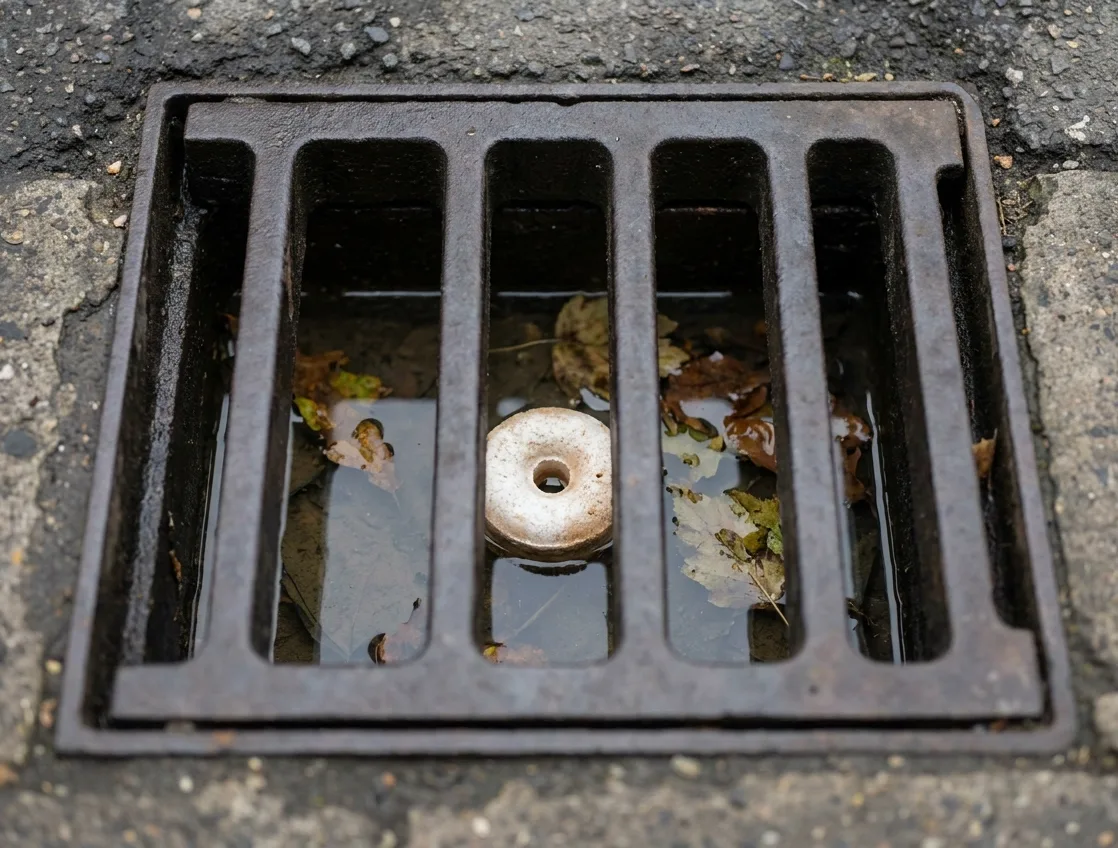
Larviciding is for water that cannot be drained. Bti (Bacillus thuringiensis israelensis) is a bacterial larvicide that kills mosquito larvae and very little else; methoprene is a growth regulator that stops larvae becoming adults. Both come as granules for small water and as slow-release briquets for catch basins, fishless ponds, rain barrels and drains, lasting weeks per placement.
Adult barrier treatment, and its limits. By day adults rest in shade — under leaves in dense shrubs, ivy and ground cover, under decks, along a woodland edge. A barrier treatment puts a residual pyrethroid such as bifenthrin or lambda-cyhalothrin on those surfaces. Before booking one, know that:
- It needs repeating, typically every three to four weeks through the season, as residue weathers and new growth appears.
- It does nothing about the source. Without source reduction, new adults arrive within days.
- Pollinators. Pyrethroids are toxic to bees, so flowering plants are left untreated and applications are made when bees are not foraging.
- Water. They are highly toxic to fish and aquatic insects, so ponds and streams get a buffer and nothing is applied before heavy rain.
Automated misting systems spray a pyrethrin product through nozzles on a timer, whether or not mosquitoes are present. They reduce biting on a patio while running, but they also dose whatever else lands on the vegetation. If you are considering one, ask how the schedule is set and whether it can be switched off remotely.
Make the yard less hospitable: prune shrubs up off the ground so air moves through them and clear leaf litter from the wooded edge.
Repellents. The CDC and EPA point to registered products using DEET, picaridin, IR3535 or oil of lemon eucalyptus (not for children under three), with permethrin for clothing only. Ultrasonic devices and apps do not repel mosquitoes, and bug zappers mostly kill moths and beetles.
Who Handles What — the County, the Owner and You
In New Jersey, mosquito control is a public service first. Every county runs a mosquito control agency — some a commission, some a county division — coordinated statewide by the NJDEP Office of Mosquito Control Coordination, with the Rutgers Center for Vector Biology providing the science. They trap and monitor, test samples for West Nile virus, larvicide public water and marshland, and take calls from residents.
Call the county first about anything beyond your own lot: a green, neglected pool next door, a flooded vacant lot, a blocked street catch basin, a stormwater basin that holds water for weeks. It costs nothing, and the county has authority under state law over breeding sites that no private contractor has.
What the county will not do is work through the containers, gutters and shrub beds on your own property. That part is ours, or yours.
Retention basins in a development belong to the homeowners' association or the municipality. One still holding water a week after rain is not working as designed, and both the owner and the county agency need to hear about it.
Standing water is the property owner's to deal with. Many New Jersey municipalities adopt a property maintenance code requiring premises to be kept free of stagnant water and pools to be kept sanitary, so a persistent source next door is also a matter for your town's code enforcement. Ask any applicator for a written record of what was applied, where, and when children and pets can go back out.
The disease question, in proportion. West Nile virus turns up in mosquito samples across this region every summer, peaking from late July into September. Most infections cause no symptoms and serious illness is uncommon, mostly in people over fifty. Eastern equine encephalitis is rare but has been recorded in New Jersey. The response to both is the same: fewer breeding sites, repellent at dusk, screens without holes.
General information about the rules as written, not legal advice about your situation. Confirm current requirements with the agency named before relying on them.
Mosquito Control — Common Questions
How often does a yard treatment need repeating?
For a barrier treatment on resting vegetation, typically every three to four weeks from late spring until the first hard frost. Heavy rain, fast new growth and pruning all shorten it. The treatments hold far better on a property where the gutters, containers and pool cover have already been dealt with, because fewer new adults are arriving each week.
The retention basin behind us seems to be the problem. What can we do?
Report it — to whoever owns it, usually the homeowners' association or the town, and to the county mosquito control agency. Standing water in a basin that should have drained is squarely what the county deals with, and a larvicide treatment there does more for the whole street than any number of yard treatments.
Do citronella candles, bug zappers or ultrasonic devices help?
Very little. Citronella has a small effect in the immediate area of the flame. Zappers mostly kill moths and beetles — biting mosquitoes are drawn to carbon dioxide and skin odour rather than light. Ultrasonic devices and apps have been tested repeatedly and do not repel mosquitoes. A fan on the patio does more than all three.
Pest Pressure in Garfield, NJ
Garfield packs about 33,000 people into just over two square miles on the east bank of the Passaic River, which makes it one of the denser small cities in Bergen County. The river is the defining feature: Garfield has a serious flood history along the River Drive corridor and the low western streets, and floodwater in this city does three things at once — it fills basements, it surcharges an older combined sewer system so that American cockroaches and rats come up through floor drains, and it leaves standing water that breeds mosquitoes for weeks.
The city's industrial past sits along that same river frontage. Former mill and works sites, rail alignment and storage yards give Norway rats unbroken harborage away from any residential block, and they are the reason rat pressure here is set at neighbourhood rather than property level.
Palisade Avenue and Outwater Lane are the commercial spines, with food businesses backing directly onto residential streets and shared rear refuse areas driving local rodent activity. The ground rises eastward from the river toward the Lodi and Saddle Brook boundaries, so the eastern streets are drier and behave more like ordinary suburban Bergen County.
Garfield uses ZIP 07026.
What Garfield Buildings Are Made Of
Garfield is mostly two- and three-family frame houses on narrow lots, a large share of them built before 1940 during the city's mill era, packed close together with narrow side yards or shared party walls.
Balloon framing is common in that stock, so the wall cavity runs uninterrupted from sill plate to attic and a mouse entering at grade turns up on the top floor. Foundations are frequently brick or rubble, which makes termite mud tubes genuinely hard to spot against an already irregular surface, and the river keeps soil damp against them for much of the year.
In the multi-family houses, stacked kitchens and bathrooms share plumbing risers running cellar to roof, with the escutcheon plates usually missing. That open gap at every floor is the German cockroach and bed bug route, and it is the reason treating one apartment in a Garfield three-family so rarely holds.
Cellars are typically unfinished with floor drains tied into old laterals — the American cockroach route every time the combined sewer surcharges. There is a layer of smaller apartment buildings along the avenues with the same riser issues at greater scale.
The Calls We Get Most in Garfield
Water bugs in cellars after heavy rain. Combined sewer surcharge into dried or broken floor drain traps.
German cockroach through every floor of a three-family. The shared kitchen riser.
Basement insects and rodents after flooding along River Drive and the low western streets.
Termites in the older frame stock. Damp soil, low sill plates, rubble foundations that hide the evidence.
Mice on the top floor with the entry at the sill. Balloon-framed walls.
Rats along the river frontage and behind the Palisade Avenue businesses.
Mosquitoes for weeks after high water.
Local Rules and Who to Call in Garfield
Garfield's health department and code enforcement handle property maintenance and pest complaints, and rental buildings of five units or more are registered under the Hotel and Multiple Dwelling Law and inspected on a cycle by the New Jersey Department of Community Affairs, Bureau of Housing Inspection — a useful second route for tenants in the avenue apartment buildings. The Bergen County mosquito control programme treats catch basins and standing water on public land at no cost and responds to reports, which matters most in the weeks after the river comes up, when breeding sites are numerous and temporary. Report conditions to the owner in writing and keep the copy before escalating.
Areas We Cover in Garfield
- River Drive corridor
- Palisade Avenue
- Outwater Lane
- Garfield Center
- Belmont Avenue area
- Passaic River frontage
- Plauderville
- Eastern Garfield
ZIP 07026 covers the city.
Garfield — Local Questions
Every heavy storm we get big roaches in the cellar. What actually stops it?
Work at the drain rather than in the room. Garfield's older sections run on a combined sewer that carries stormwater and sewage together, and when it surcharges American cockroaches come up through floor drains, particularly where the trap has dried out or cracked. Keeping traps primed with water, fitting a proper drain cover and sealing gaps at the cellar entry stops far more of this than any interior treatment does.
Our foundation is old stone. Can you even tell if we have termites?
It is harder, and any honest inspector will say so. Mud tubes are much easier to see on smooth poured concrete than on irregular brick or rubble, and on the river side of Garfield the soil stays damp against the foundation for most of the year, which is exactly what subterranean termites want. It means the inspection takes longer, relies more on probing the sill plate and rim joist, and that any limits on access get written on the report rather than glossed over.
Mosquito Control Near Garfield
We cover the surrounding towns from the same base, so if you are just outside Garfield the nearest service pages are below.
- Mosquito Control in Passaic, NJ 2 mi
- Mosquito Control in Clifton, NJ 3 mi
- Mosquito Control in Hackensack, NJ 3 mi
- Mosquito Control in Fair Lawn, NJ 4 mi
- Mosquito Control in Paterson, NJ 4 mi
In Garfield we also handle pest control, rodent control, bed bug treatment, cockroach control, and termite treatment. Our main service pages cover cockroach control, termite treatment and mosquito control.
📍 On the map
Can't Use the Yard After Dusk?
Most biting mosquitoes breed within a short flight of where they bite. Book a free estimate and we will find the water first.
Call About MosquitoesHow Mosquito Control Runs in Garfield
Four stages, from the first bite to a quieter yard
Mosquito control is a season-long job in this climate, and it starts on the ground. This is the sequence a Garfield property follows.